Companion video (YouTube): original English narration, switchable Chinese dubbing, Chinese and English subtitles
The starting point of this series is a teacher of mine. He is always willing to share something with everyone on WeChat Moments.
I am not an expert, nor a professor, just a person who likes science. In the age of artificial intelligence I often feel lost, but I have not given up the things I love.
This series is dedicated to people who are just as lost: to those who dare to face the unknown, to those who walk into the unknown to explore it, and also to those who have never stopped, who keep walking toward their dreams.
And let us also not forget those pioneers.
In 1892, in Bonn, a small hole was made in a discharge tube, and a piece of aluminum foil was sealed over the hole. This episode starts from this small window: what cathode rays are, why they had to be brought out of the tube, what kind of man Lenard was, how from the bending of the rays he measured how fast they go and how light they are, and how he knew that the atom is mostly empty; then we work these steps out for ourselves, then tell of the 1905 prize, and finally come the feuds between him and Einstein, and between him and Röntgen.
A small window
1892, the physics institute of the University of Bonn, in Germany. An assistant named Lenard made a small hole in a discharge tube and sealed it with a piece of aluminum foil.
He sprinkled a few grains of phosphor on this little window and switched on the current. Phosphor glows without being heated: when rays strike it, it lights up.
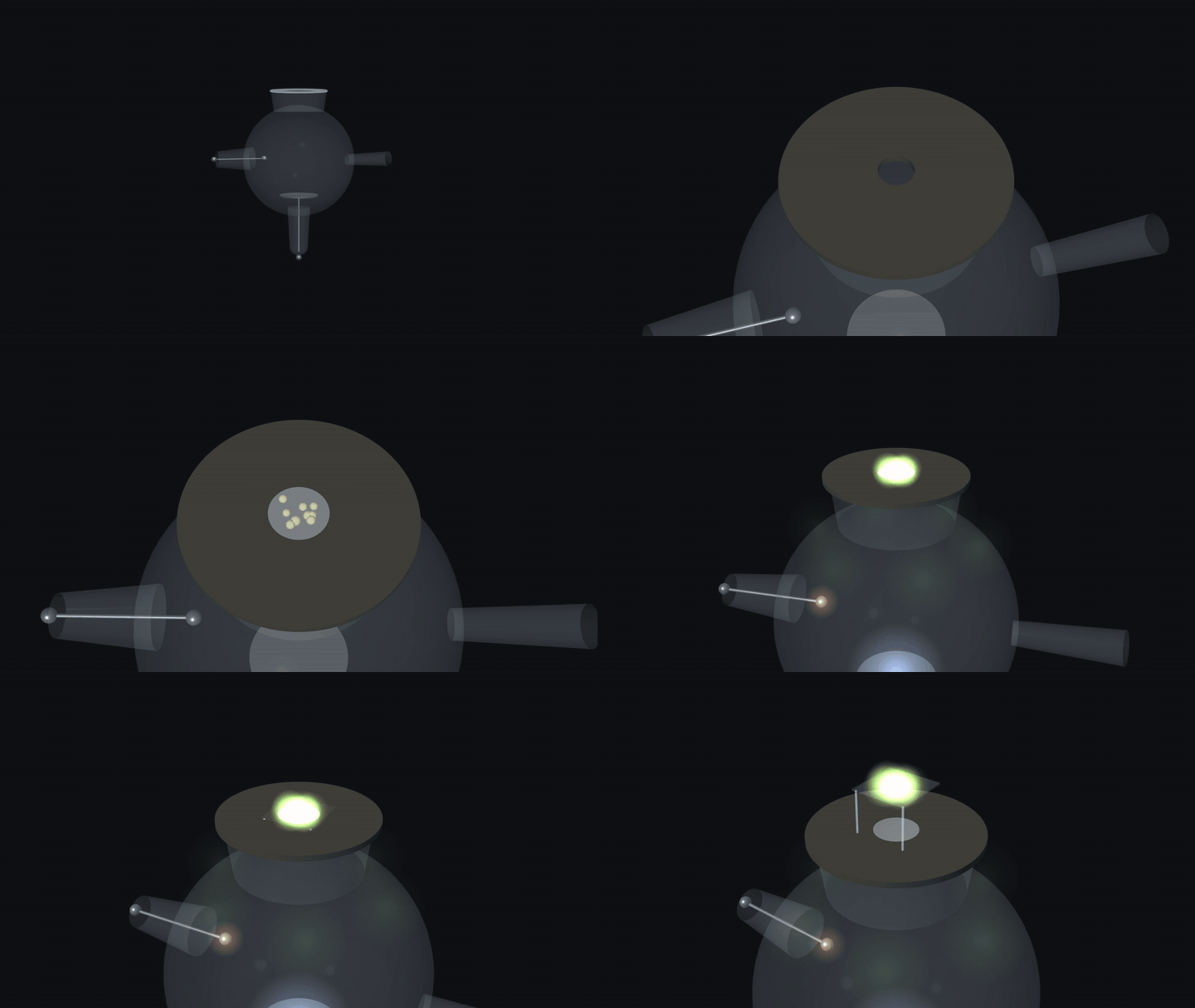
Figure 1. 1892, the physics institute of the University of Bonn, in Germany. An assistant named Lenard made a small hole in a discharge tube and sealed it with a piece of aluminum foil. He sprinkled a few grains of phosphor on this little window and switched on the current. Phosphor glows without being heated: when rays strike it, it lights up. In his Nobel lecture he later recalled: lo and behold, the grains glowed brightly. He then fixed the phosphor slightly above the window, outside it, and it still glowed.
In his Nobel lecture he later recalled: lo and behold, the grains glowed brightly!
He then put the phosphor slightly above the window, outside it, and it still glowed.
For the first time, the cathode rays inside the tube had been brought out into the open air.
And thirteen years later, in 1905, he won the Nobel Prize in Physics for cathode rays.
In that same year, a paper by Einstein even mentioned another piece of Lenard’s work, and called it pioneering.
Yet fifteen years after that, he and Einstein would argue face to face at a meeting. And fifteen years after that, in an institute named after him, he called on those present to keep up the fight against the “Jewish spirit”.
This episode begins with that small window. What are cathode rays? Why bring them out of the tube at all? And what happened between him and Einstein, and between him and Röntgen.
Bringing them out of the tube
Lenard did not discover cathode rays. The presentation speech of 1905 says so at the very start: they were discovered by Hittorf as long ago as 1869, only that was too early, and there was no Nobel Prize yet.
Take a glass tube, pump it very empty, and put a high voltage across its two ends; the end connected to the negative pole is called the cathode. Out of the cathode comes something invisible, and where it strikes the glass opposite, the glass glows. These are cathode rays, and a tube like this is called a discharge tube.
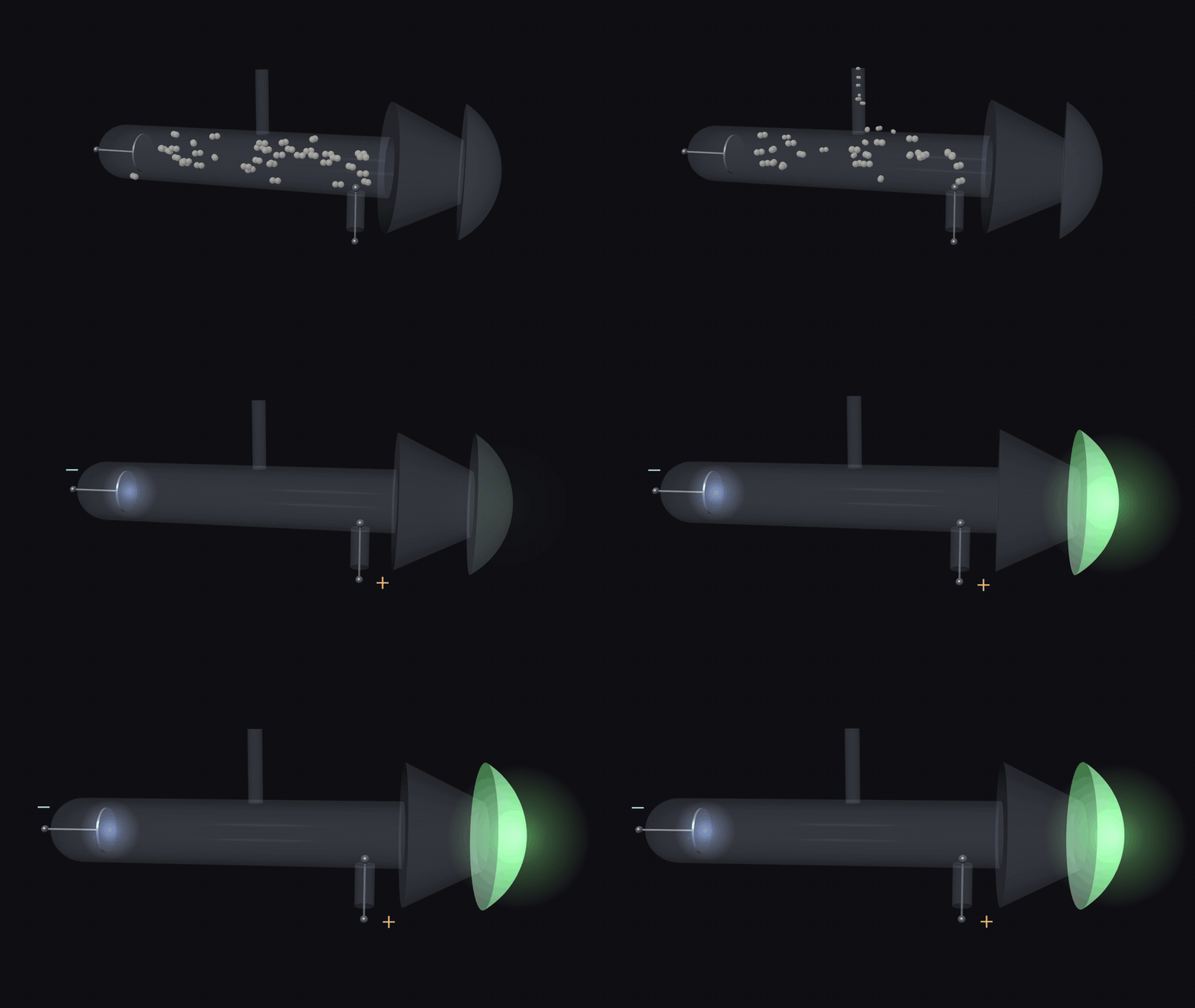
Figure 2. Take a glass tube, pump it very empty, and put a high voltage across its two ends; the end connected to the negative pole is called the cathode. Out of the cathode comes something invisible, and where it strikes the glass opposite, the glass glows. These are cathode rays, and a tube like this is called a discharge tube.
First, the answer. In 1897 the British physicist J. J. Thomson measured the ratio of their mass to their charge, and found it far smaller than the same ratio for the hydrogen ion, only about a thousandth of it. They turned out to be particles much smaller than atoms, carrying negative charge, which we call electrons.
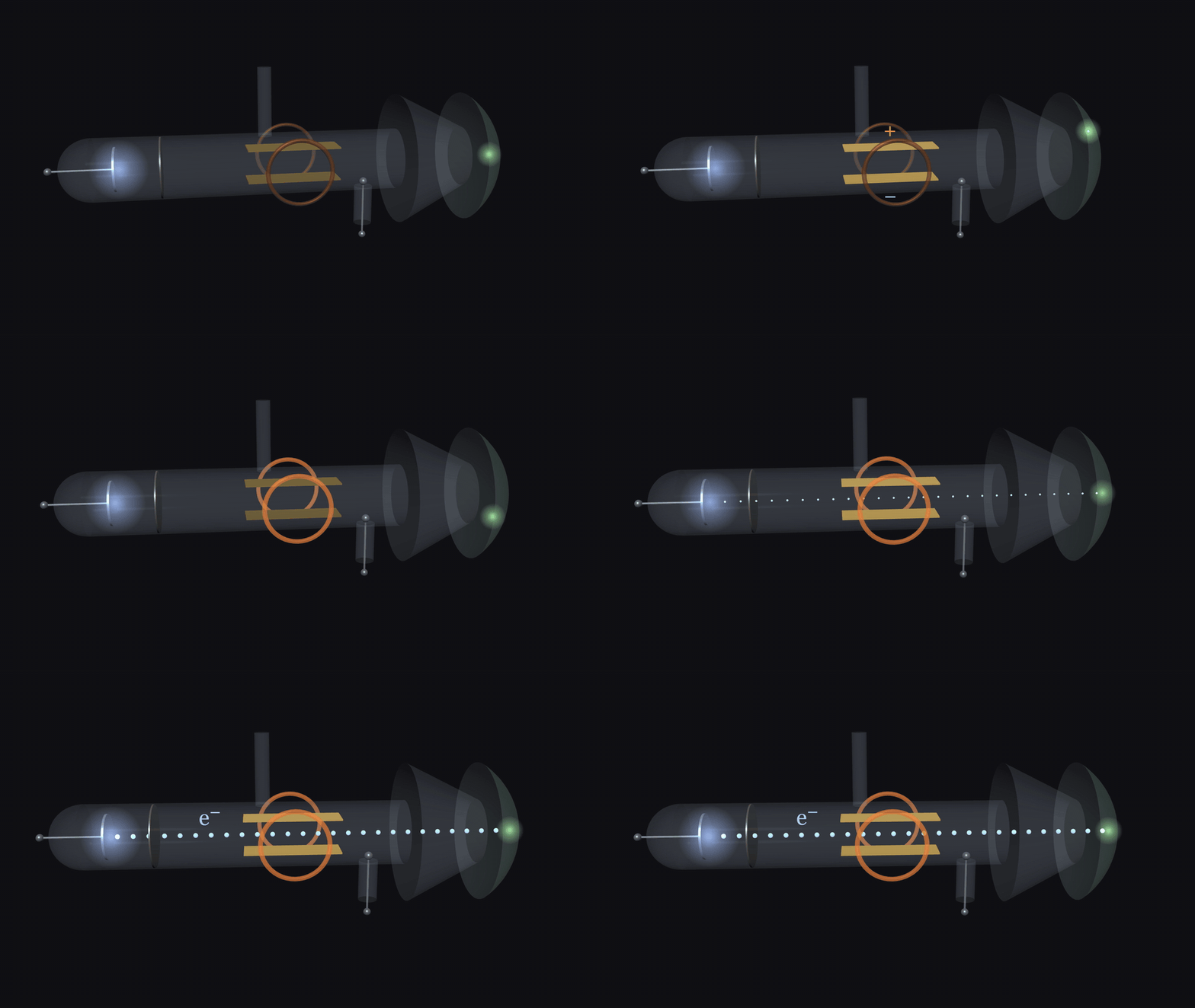
Figure 3. First, the answer. In 1897 the British physicist J. J. Thomson measured the ratio of their mass to their charge, and found it far smaller than the same ratio for the hydrogen ion, only about a thousandth of it. They turned out to be particles much smaller than atoms, carrying negative charge, which we call electrons.
But before that, people were split into two camps over what they were. According to the presentation speech, the German view held them to be vibrations in the ether, rather like light; the English view, put forward mainly by Crookes, held them to be particles, each carrying a negative charge.
The ether was something physicists of the time imagined: it filled all of space, even space that had been pumped empty. Light was thought of as waves in the ether, the way sound is waves in the air.
Lenard himself started out from the German view.
To find out what they are, the best thing would be to take them out of the tube and look at them on their own. In his lecture Lenard said he thought how fine it would be to bring these rays from the tube out into the open air; it would then be possible to carry out direct experiments with them.
The tube had to be pumped very empty: with too much gas, the rays run into gas molecules as soon as they leave the cathode, and get nowhere, and the tube is filled with nothing but a glow. Yet it could not be pumped completely empty either: Crookes had already said in his lecture of 1879 that if you pump too far, the current will no longer pass.
But inside the tube is a vacuum, and outside is air. Open a hole and the air rushes in; leave it closed and the glass stops the rays.
He had first tried once himself. At that time he was still in Heidelberg as Quincke’s assistant; he built a tube, made an opening at its top, and sealed it with a quartz plate 2.4 millimeters thick. In his lecture he said: the test was unsuccessful.
In 1892, a chance came.
By then he was in Bonn, as assistant to Hertz.
He wrote in his lecture: one day Hertz called him over, an event which to his great regret did not occur often, and showed him what he had just found.
Inside a discharge tube lay a piece of uranium glass, covered with a layer of aluminum leaf. When cathode rays strike uranium glass it glows green, so it shows where the rays land; anything else that lights up when struck would also do, but Hertz said uranium glass was best. The aluminum leaf on top was there to see whether the rays could pass through metal: the leaf does not let light through, so if the glass under the leaf lit up, only the rays could have done it. The rays came down from above, and the uranium glass under the leaf lit up: the rays had passed through the aluminum leaf.
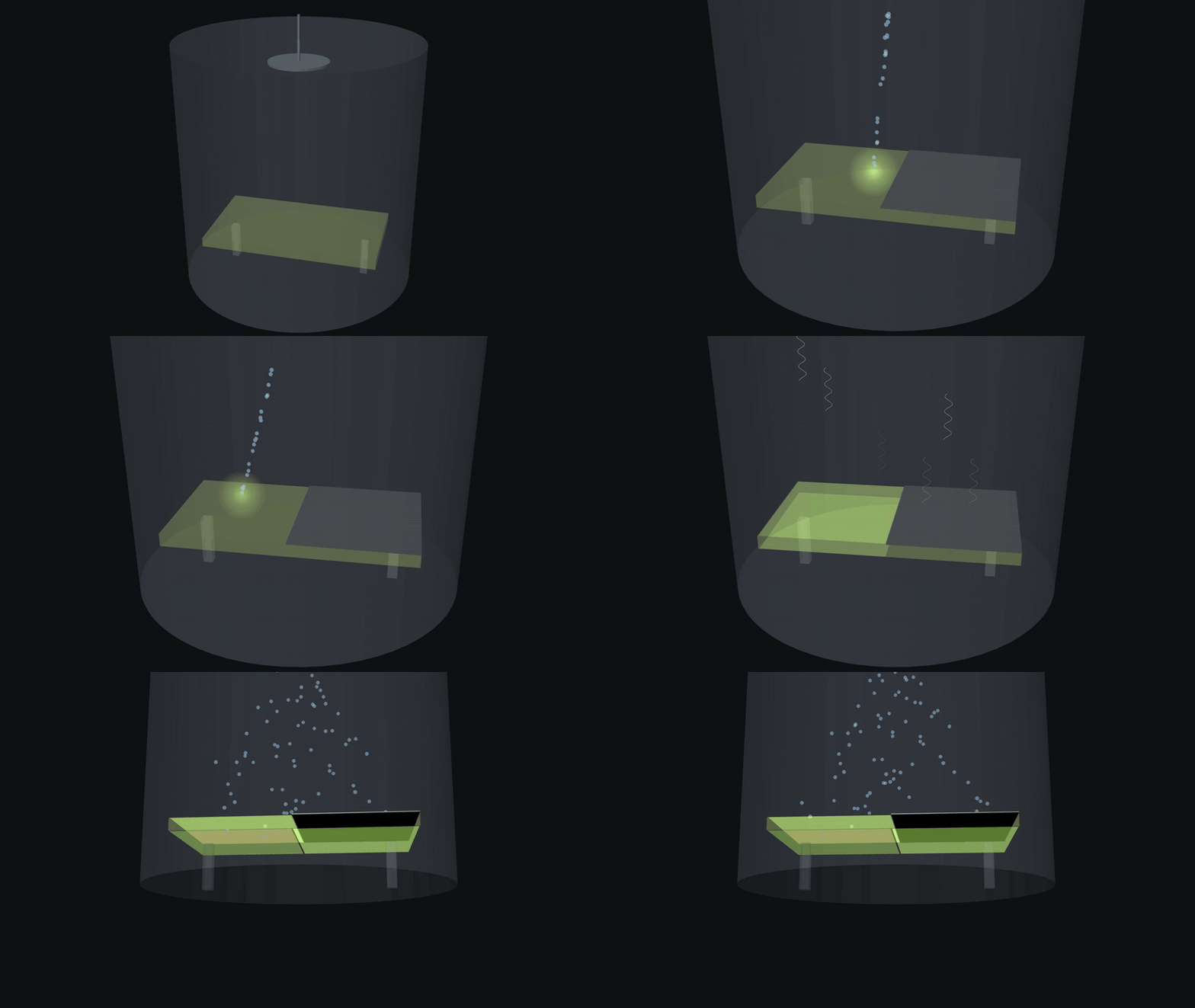
Figure 4. Inside a discharge tube lay a piece of uranium glass, covered with a layer of aluminum leaf. When cathode rays strike uranium glass it glows green, so it shows where the rays land; anything else that lights up when struck would also do, but Hertz said uranium glass was best. The aluminum leaf on top was there to see whether the rays could pass through metal: the leaf does not let light through, so if the glass under the leaf lit up, only the rays could have done it. The rays came down from above, and the uranium glass under the leaf lit up: the rays had passed through the aluminum.
Hertz wrote in his paper that metals are completely opaque to light, yet let cathode rays through to some extent, and that this was what made it so striking.
Hertz said to him: we ought to separate two chambers with aluminium leaf, and find out whether the rays are phenomena in matter or phenomena in ether.
Lenard later made it plain in a footnote to his paper: it was Professor Hertz himself who had asked him to use metal leaf, and he was very grateful to him for it.
Then comes the scene from the beginning. He fitted a metal plate to the top of the tube, with a small hole in it, sealed with a piece of aluminum foil. The phosphor glowed.
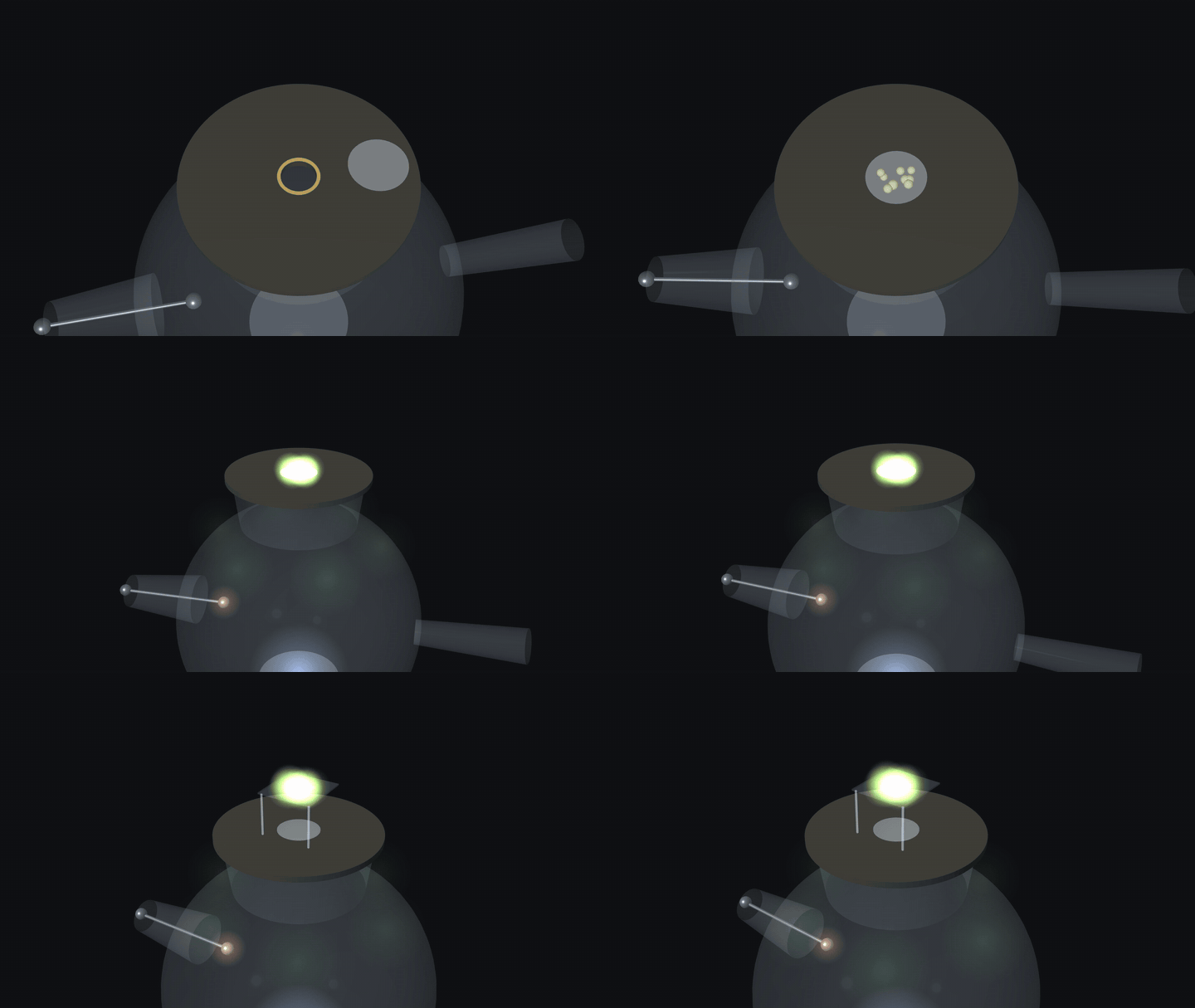
Figure 5. Then comes the scene from the beginning. He fitted a metal plate to the top of the tube, with a small hole in it, sealed with aluminum foil. The phosphor glowed.
The foil let no air through, yet the rays passed through it. Out in the open air they even traveled almost a decimeter.
He gave the foil a name: the window. The space beyond it he called the observation chamber.
The rays were out, but the eye could not see them. He said it would be useless to put one’s eye to the window, as this organ is not receptive to cathode rays.
You had to catch them on a sheet of paper coated with such a glowing material. If the paper lit up, the rays had reached it.
In the first episode, this is just how Röntgen found X-rays: the rays were invisible, but two meters away a paper screen coated with barium platinocyanide lit up.
In the air the rays spread out as they went. He said it was just as if light had been passed through the same hole into a tank of slightly diluted milk.
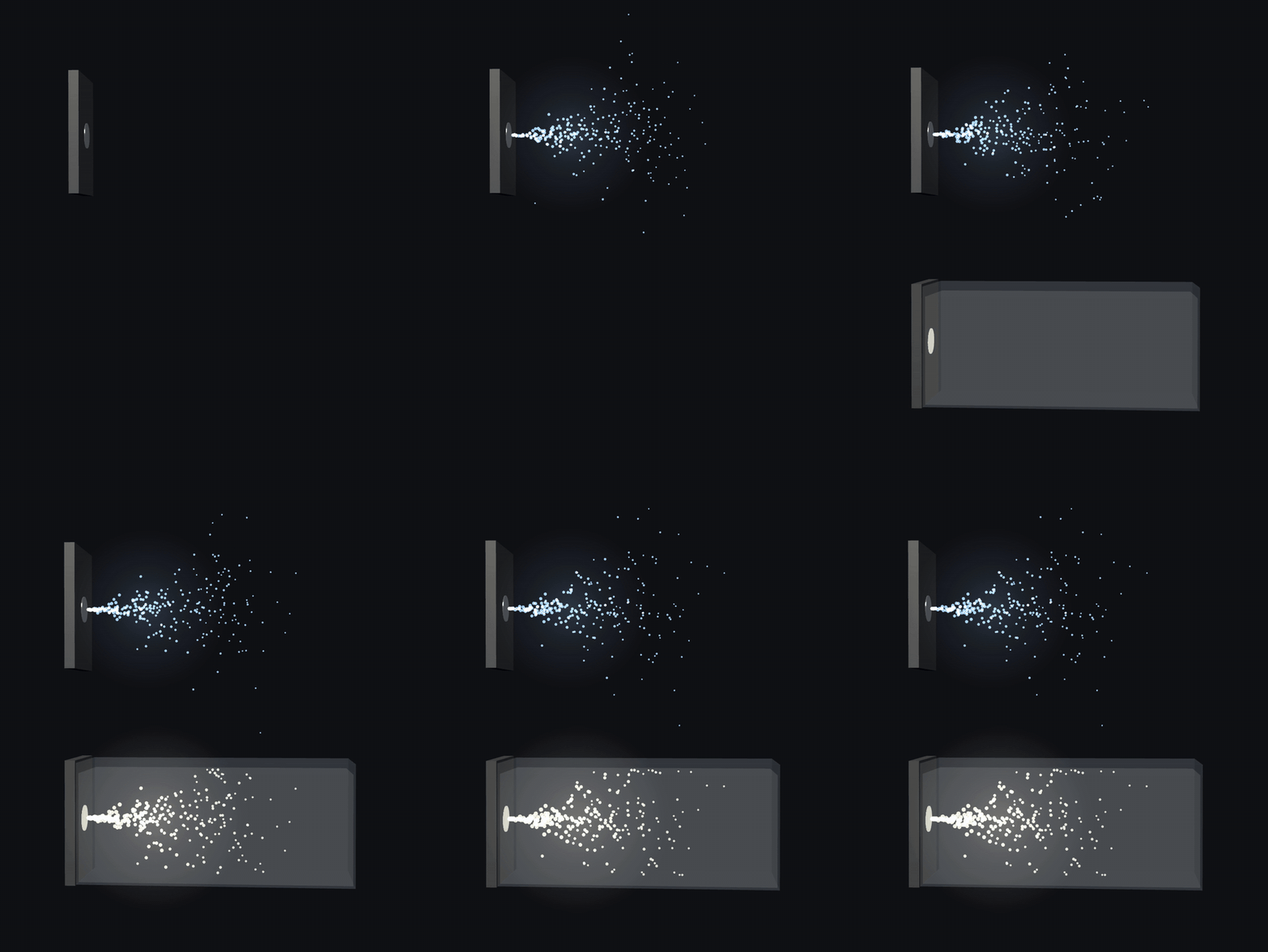
Figure 6. In the air the rays spread out as they went. He said it was just as if light had been passed through the same hole into a tank of slightly diluted milk.
He also used a magnet to bend the rays outside the window. The rays curved, and his explanation at the time was that the ether between the magnet’s poles had been changed. He was still on the German side.
On January 1, 1894, Hertz died, aged only 36. Hertz’s posthumous works were edited and published by Lenard.
Others soon took up his window. At the end of 1895, the paper in which Röntgen announced X-rays named, in its first sentence, among the apparatus it used, a Lenard tube.
In the same paper, Röntgen also praised Lenard’s experiments. The next year, the Royal Society awarded the Rumford Medal jointly to Röntgen and Lenard.
With the window in hand, what Lenard did next was to measure, one material after another, how strongly each one stops cathode rays. He measured a large number of solids and gases.
In his lecture he said the result was astounding: the sole determining characteristic was the weight. Of equal thicknesses of aluminum, silver and gold, gold, the heaviest, stopped the most; with equal weights of the three, the shadows were equally deep. What a thing was made of, whether it was solid or gas, hardly mattered at all.
The presentation speech says it was his own experiments that made the German view untenable.
Lenard’s explanation was that an atom is mostly empty, which is why electrons can pass through thin aluminum foil. On the way they are pulled aside and slowed down, again and again, by the electric forces inside the atoms; in thicker foil they do not get far before they stop.

Figure 7. Lenard’s explanation was that an atom is mostly empty, which is why electrons can pass through thin aluminum foil. On the way they are pulled aside and slowed down, again and again, by the electric forces inside the atoms; in thicker foil they do not get far before they stop.
Now that we know what Lenard did, let’s take a closer look at what kind of man he was.
The man
Philipp Lenard was born on June 7, 1862, in Pozsony, in Hungary, Pressburg in German, today Bratislava, the capital of Slovakia. His father was a wine merchant.
At school, physics and chemistry were, in his own words, “oases in the desert of everything else”.
Already at secondary school he was doing experiments on phosphorescence with one of his teachers. Those few grains of phosphor on the little window at the beginning were nothing new to him: he worked on phosphorescence, on and off, for forty years.

Figure 8. In the 1903 episode, Becquerel also started from phosphorescence: he wanted to know whether a phosphorescent uranium salt might also give off something like X-rays, and he discovered radioactivity.
In the 1903 episode, Becquerel also started from phosphorescence: he wanted to know whether a phosphorescent uranium salt might also give off something like X-rays, and he discovered radioactivity.
He met cathode rays early, too. In his Nobel lecture he said the start takes him back 26 years to Crookes: that was 1880, when he read Crookes’s lecture on “radiating matter” and was greatly impressed by it.
After secondary school he first studied for two semesters at the technical colleges in Budapest and Vienna, was satisfied with neither, and then spent a year helping in his father’s business. Only in 1883 did he come to Heidelberg and begin to study physics.
By the way, I have been to Heidelberg; I like it very much, it’s a lovely city.
In Heidelberg he studied physics under Quincke and Bunsen, and also spent a year in Berlin. His doctoral thesis was on how falling drops vibrate, a topic suggested by Helmholtz. In 1886 he took his doctorate in Heidelberg.
He then stayed on as Quincke’s assistant, and built himself a mercury air pump capable of giving very high rarefaction. Mercury is heavy and liquid, so it can push the last of the gas out of a tube, a little at a time. He said that such a pump was then by no means a standard item of equipment in physics institutes. The tube sealed with the quartz plate, mentioned earlier, was made at this time.
After Hertz died, he went in turn to Breslau, Aachen and Heidelberg, and in 1898 he became full professor at Kiel, where he still was when he won the prize in 1905.
The next year, at the start of his Nobel lecture, he said that he had by no means always been among those who pluck the fruit; he had repeatedly been only one of those who planted or cared for the trees.
Lenard:
- June 7, 1862, born in Pressburg (today Bratislava)
- About 1880, read Crookes’s lecture on “radiating matter”
- From 1883, studied physics in Heidelberg, and also spent a year in Berlin
- 1886, doctorate in Heidelberg
- 1886–1889, Heidelberg, Quincke’s assistant
- From 1891 (by another account 1892), Bonn, Hertz’s assistant
- 1892, the aluminum-foil window
- 1894, Breslau; 1895, Aachen; 1896, Heidelberg
- 1896, Rumford Medal, shared with Röntgen
- 1898–1907, full professor at the University of Kiel
- 1902, paper on the photoelectric effect: the maximum speed of the electrons does not depend on the intensity of the light
- 1905, Nobel Prize in Physics
- From 1907, professor at the University of Heidelberg
- September 1920, Bad Nauheim, debate with Einstein
- December 1935, the physics institute in Heidelberg renamed the “Philipp Lenard Institute”
- 1936, first volume of Deutsche Physik
- 1937, joined the Nazi Party
- May 20, 1947, died in Messelhausen
Two accounts side by side
On a few matters the sources do not agree, so we write down both sides.
As for the year he went to Bonn as Hertz’s assistant, the German biographical dictionary NDB gives April 1891, and the biography on the official Nobel website gives from 1892 on. What can be settled from primary sources is this: in May 1892 he was already publishing a paper in Bonn, signed from the physics institute of the University of Bonn; and the Nobel lecture also says that in 1892 he was Hertz’s assistant.
As for the year the window experiments began, the NDB and the German Historical Museum give 1892, and the official website and the presentation speech of 1905 give 1893. In January 1893 he first published a short report in the proceedings of the Berlin Academy of Sciences.
For the 1922 incident in Heidelberg, the NDB gives June 22, and the German Historical Museum June 27. Rathenau was assassinated only on June 24, and the Berliner Tageblatt reported the assassination in its morning edition of June 25; June 22 comes before the assassination and does not fit. The Heidelberg disturbance appeared in the Berliner Tageblatt only in the evening edition of June 28, describing the day before, so the 27th is more likely. That report does not connect the cancelled classes with Rathenau; the link between the two comes from the Nazi commemorative volume of 1937.
Rays that bend
Ever since Hittorf’s day, it had been known that cathode rays are deflected by magnets.
Later it was found that they also bend between two charged metal plates.
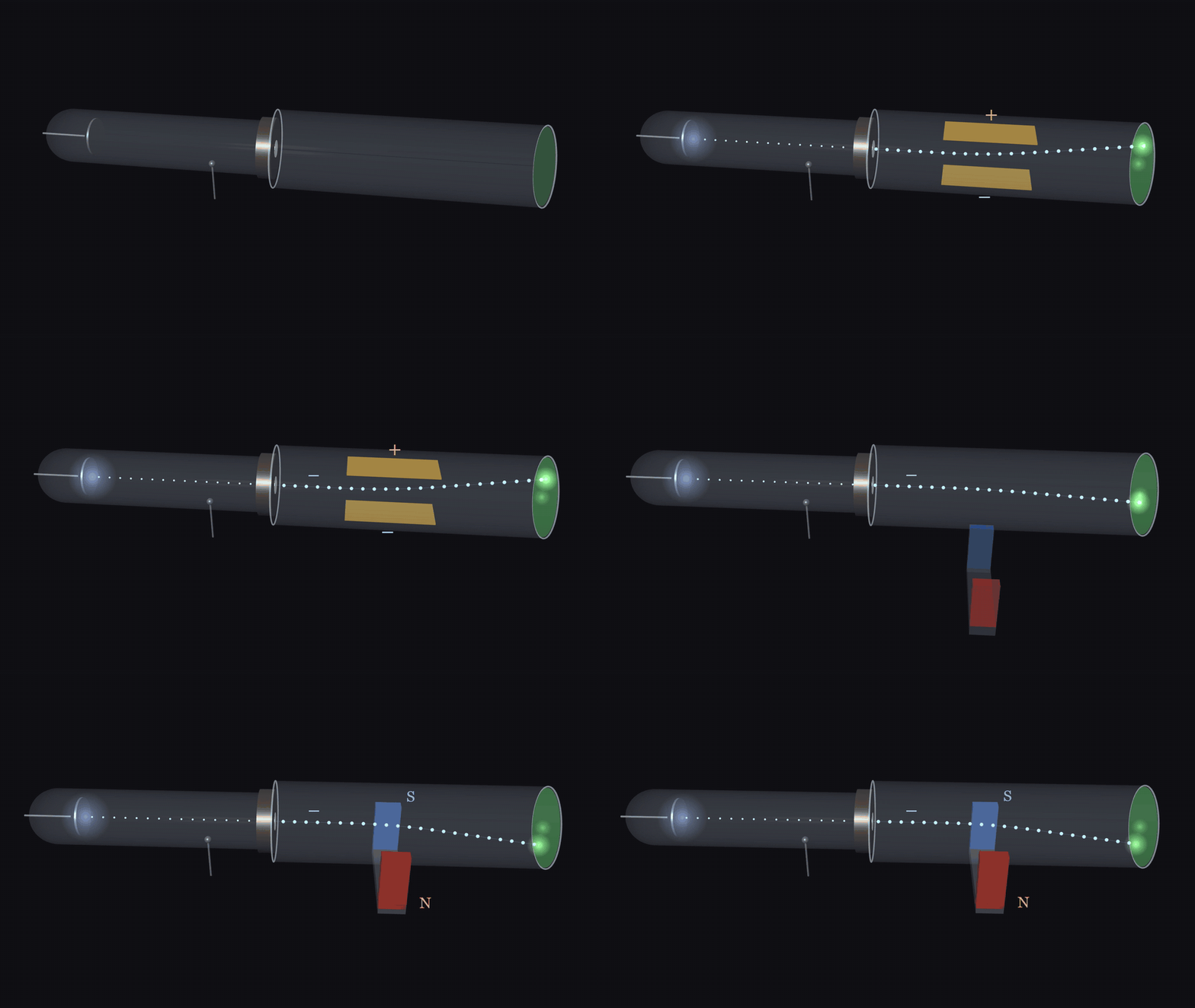
Figure 9. Later it was found that they also bend between two charged metal plates. Being bent by charged plates shows that they carry electricity; bending towards the positive plate shows that it is negative. And the way a magnet bends them is just the way a moving negative charge ought to bend.
Being bent by charged plates shows that they carry electricity; bending toward the positive plate shows that the charge is negative. And the way a magnet bends them is just the way a moving negative charge ought to bend.
How sharply they bend depends on how fast they go and on how much charge each unit of mass carries. Turned around, one measurement of the bending under a magnet and another between charged plates, taken together, give both numbers.
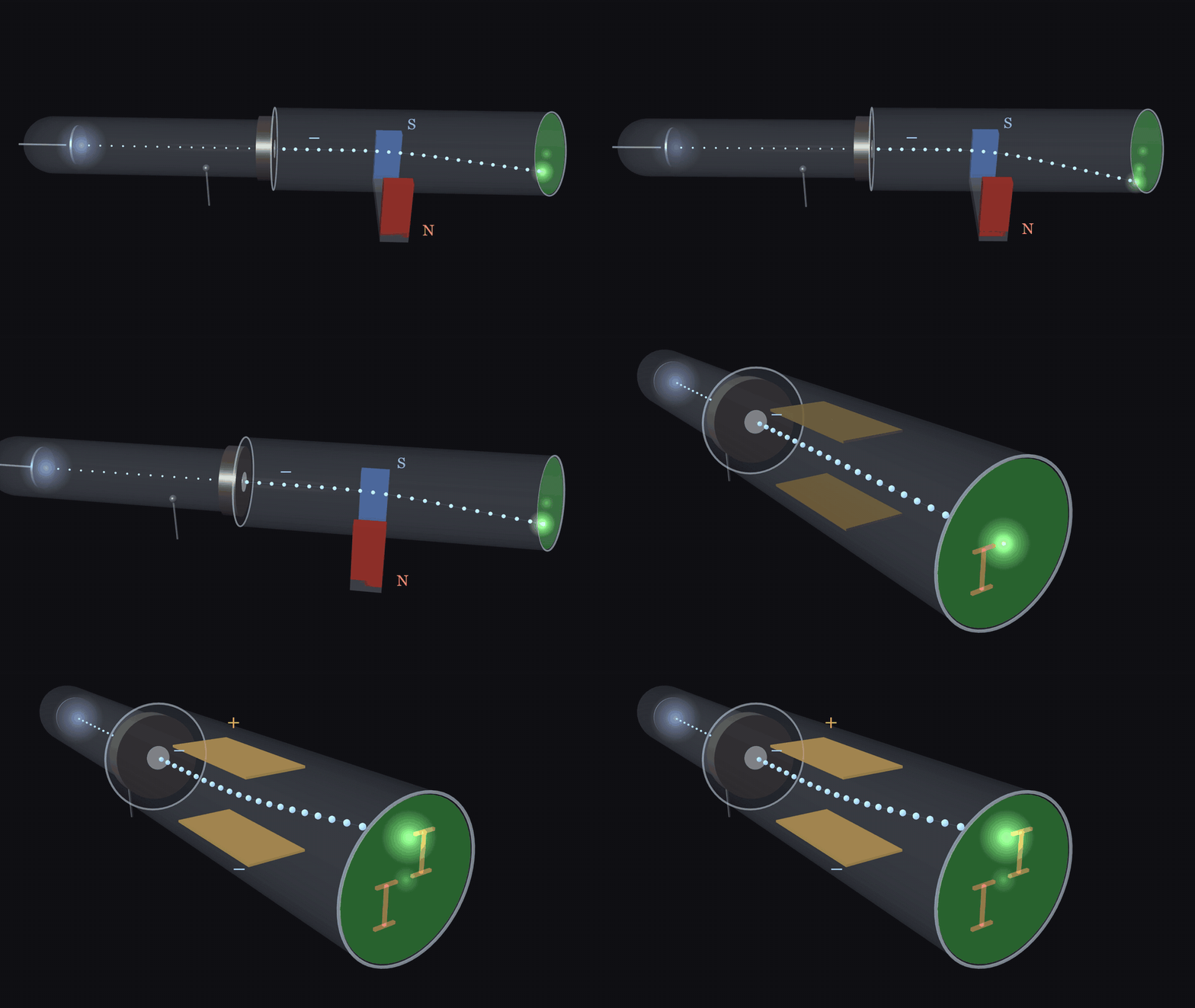
Figure 10. How sharply they bend depends on how fast they go and on how much charge each unit of mass carries. Turned around, one measurement of the bending under a magnet and another between charged plates, taken together, give both numbers.
Hertz and Schuster had both measured it this way, but their results had contradicted each other.
Lenard thought the trouble lay inside the tube: there was gas in it, and the discharge, all mixed up together.
Thomson was the first to publish such a measurement, made while the rays were still inside the tube.
Lenard wanted to measure outside the tube: the rays came out through the window into a second space, pumped to a very high vacuum, with no gas and no discharge, only the rays themselves.
In such a vacuum the rays attain lengths of several meters, straight and sharp, like light.
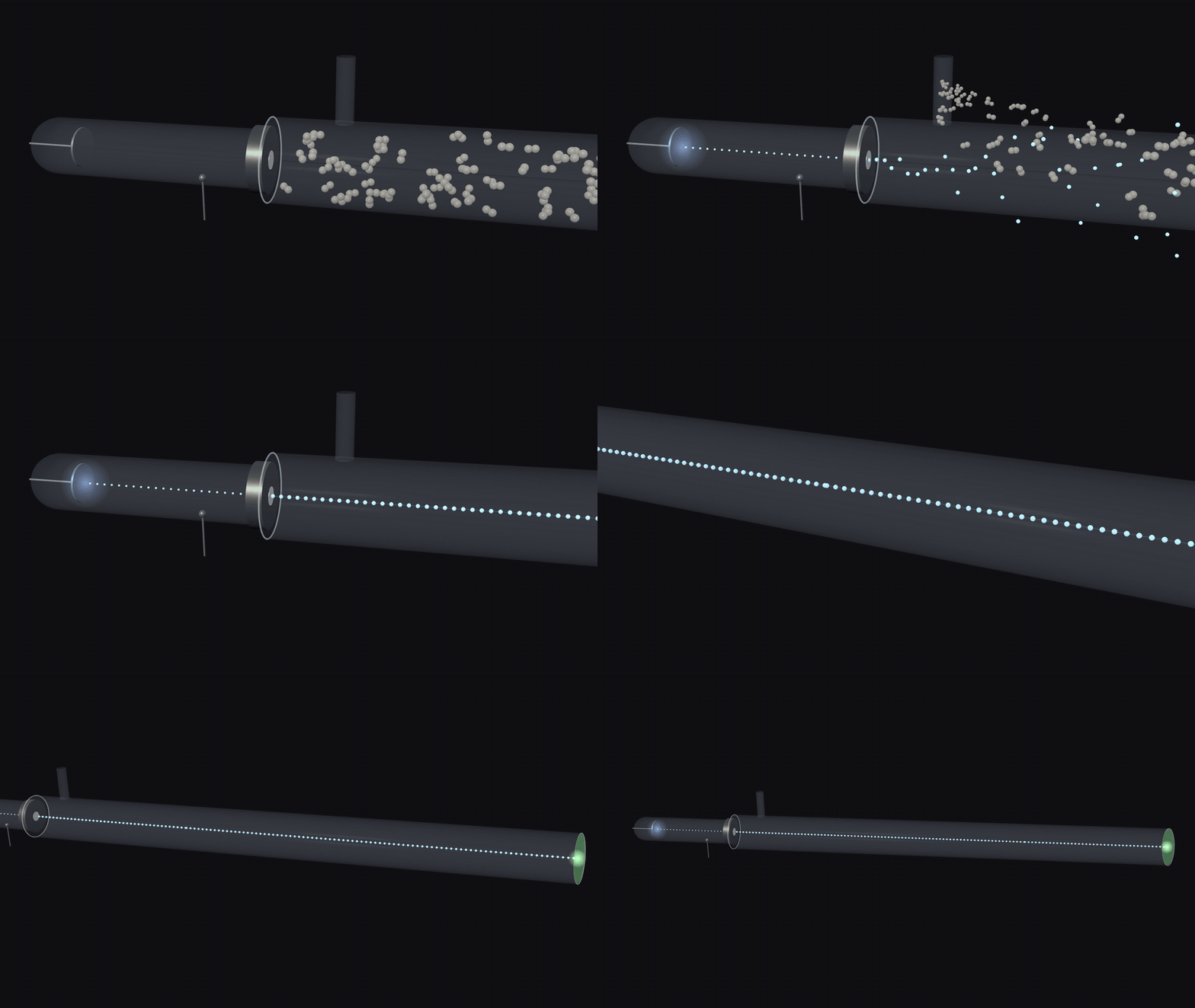
Figure 11. Lenard wanted to measure outside the tube: the rays came out through the window into a second space, pumped to a very high vacuum, with no gas and no discharge, only the rays themselves. In such a vacuum the rays attain lengths of several meters, straight and sharp, like light.
What he found was this: the rays travel at about one third the velocity of light.
And the charge per unit of mass is about a thousand times that of a hydrogen atom in electrolysis.
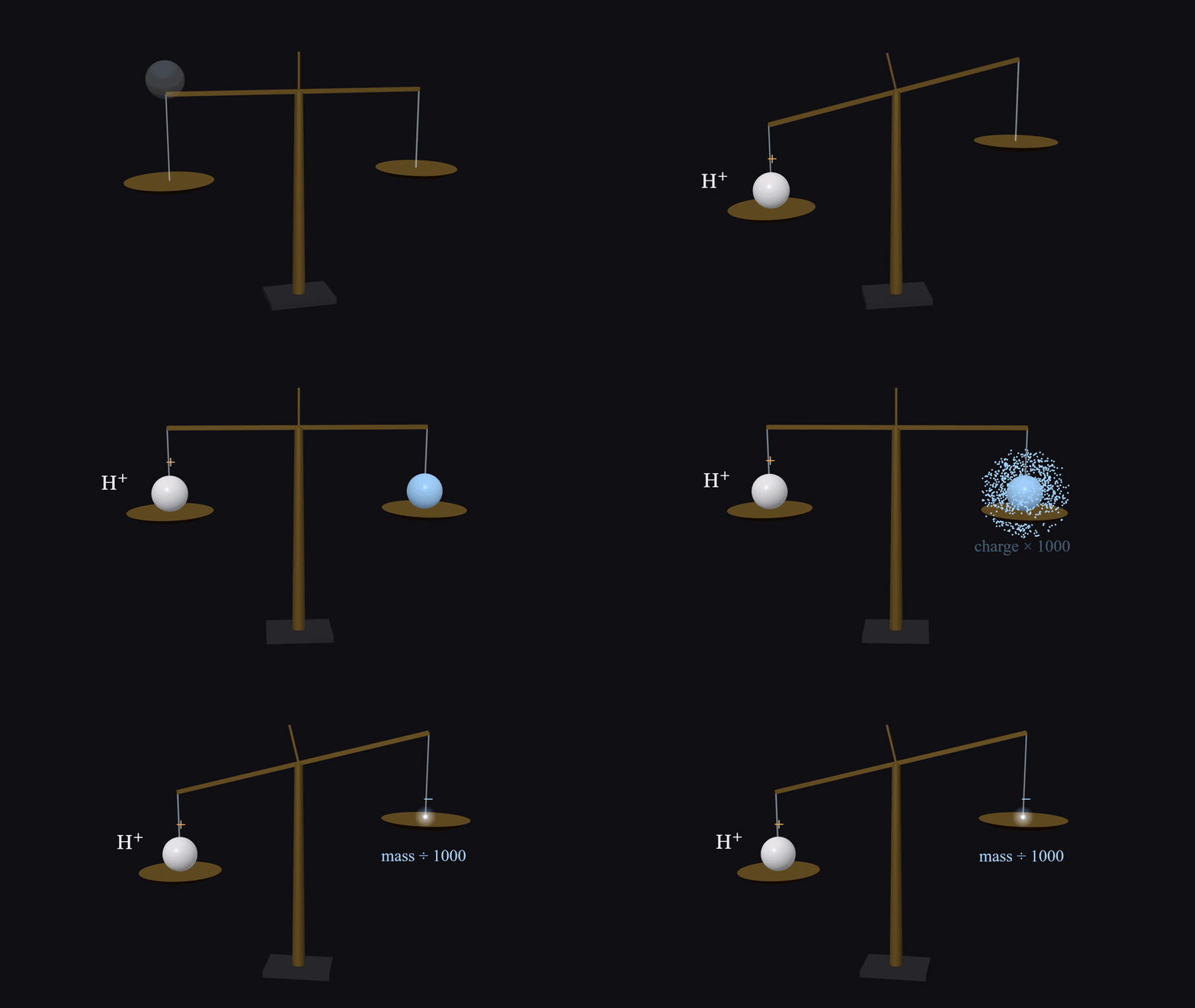
Figure 12. The hydrogen ion in electrolysis was the thing known at the time to carry the most charge for its mass. So whatever carries the charge in the rays has either a thousand times its charge, or only a thousandth of its mass.
The hydrogen ion in electrolysis was the thing known at the time to carry the most charge for its mass. So whatever carries the charge in the rays has either a thousand times its charge, or only a thousandth of its mass.
In Lenard’s words, what we find in cathode rays is electricity without material, electrical charges without charged bodies.
Today we call it the electron, and its mass is about one eighteen-hundredth of a hydrogen atom’s.
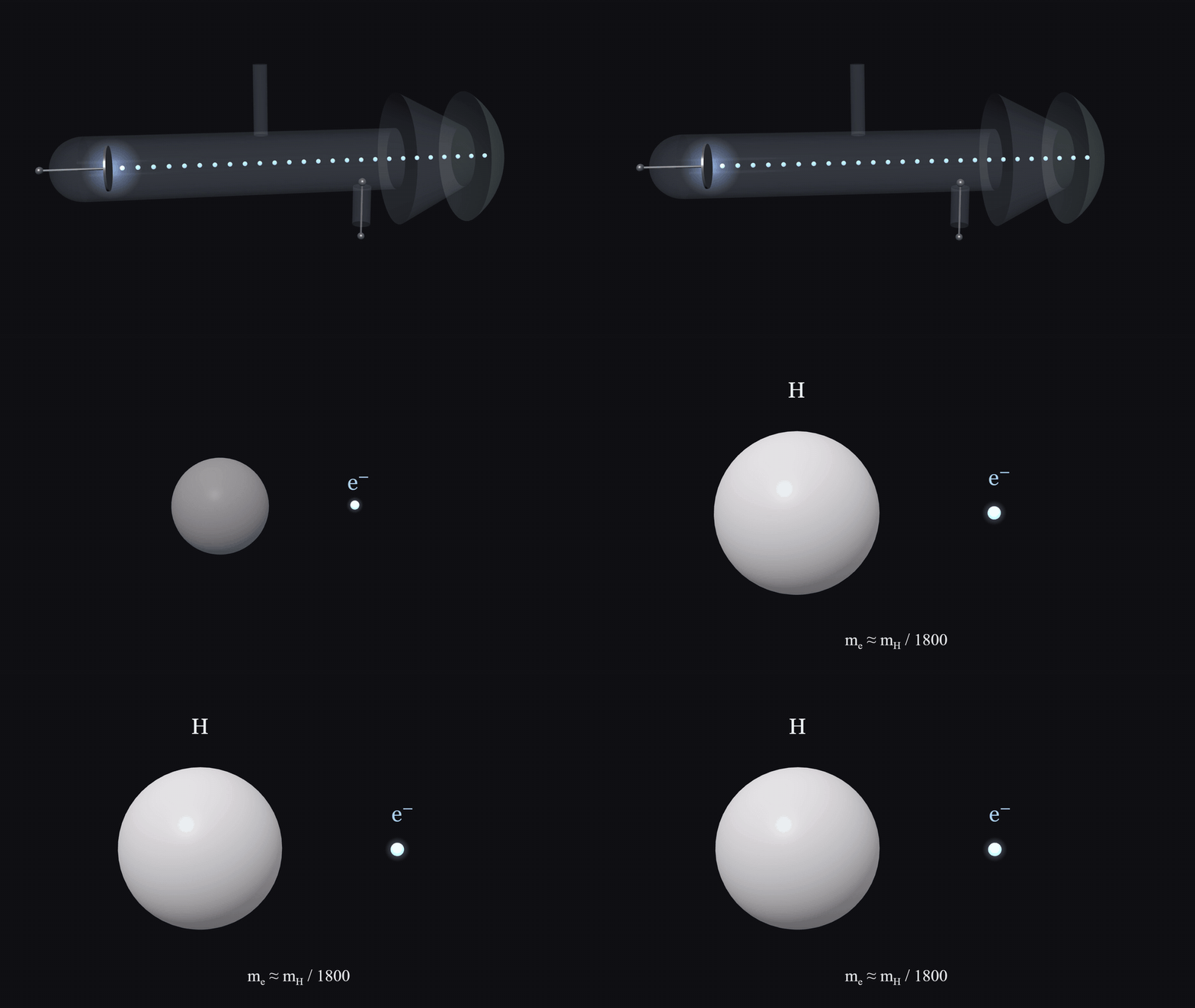
Figure 13. Today we call it the electron, and its mass is about one eighteen-hundredth of a hydrogen atom’s.
The emptiness they pass through
As we saw earlier, how much of the cathode rays is stopped depends, roughly, only on how much the layer in the way weighs over each patch of area.

Figure 14. As we saw earlier, how much of the cathode rays is stopped depends, roughly, only on how much the layer in the way weighs over each patch of area.
From this Lenard went a step further: the atoms of the different elements vary not qualitatively but only quantitatively, in how much of one basic material they contain.
He sent two beams through the same space from opposite directions, and they did not interfere with each other in the slightest.
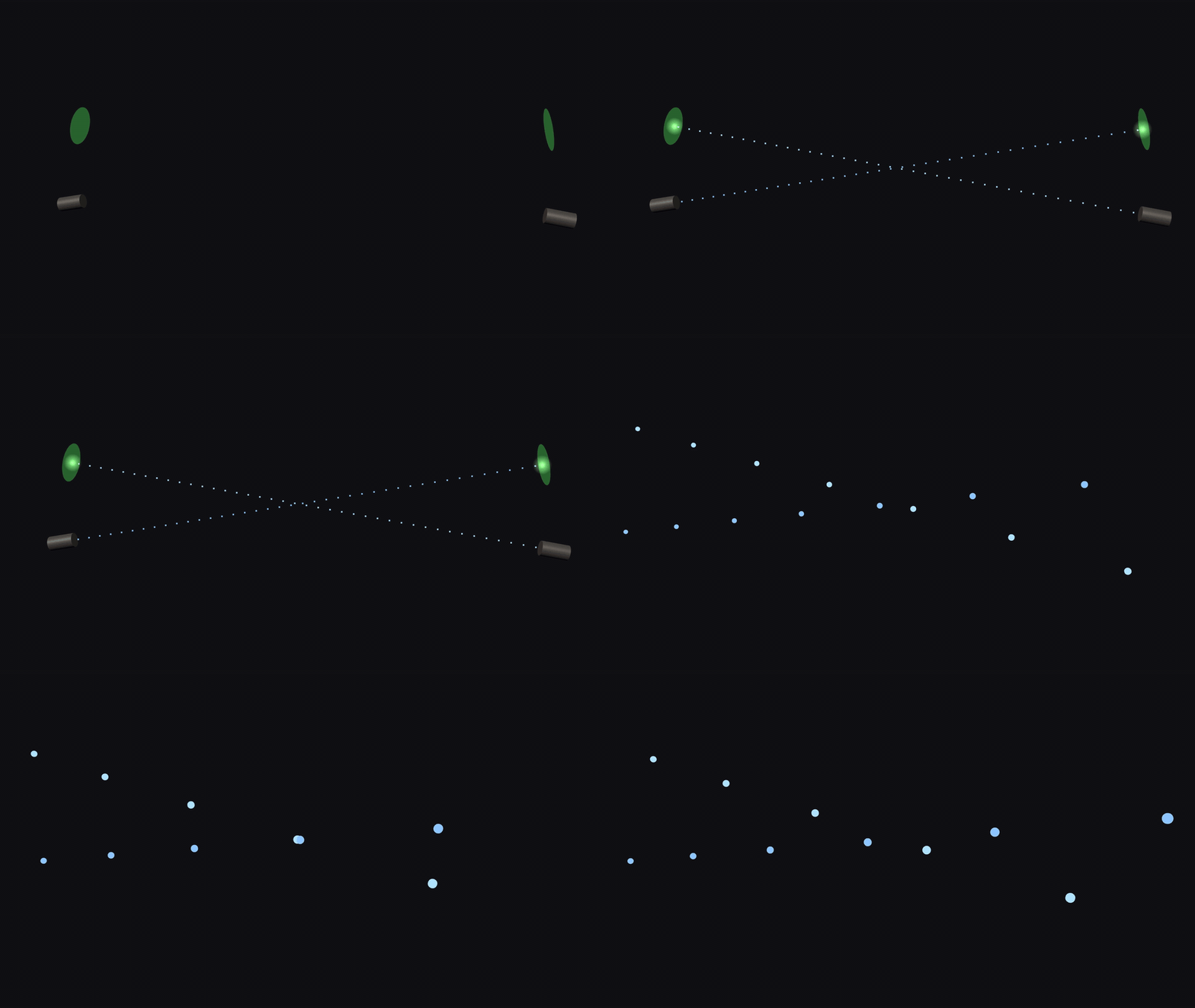
Figure 15. He sent two beams through the same space from opposite directions, and they did not interfere with each other in the slightest. This, he said, showed that the electricity of these rays consists of discrete and very small parts, separated by a large volume of free space.
This, he said, showed that the electricity of these rays consists of discrete and very small parts, separated by a large volume of free space.
How fast the rays go depends on the voltage across the tube: the higher the voltage, the faster. And the faster the rays, the more easily they get through.
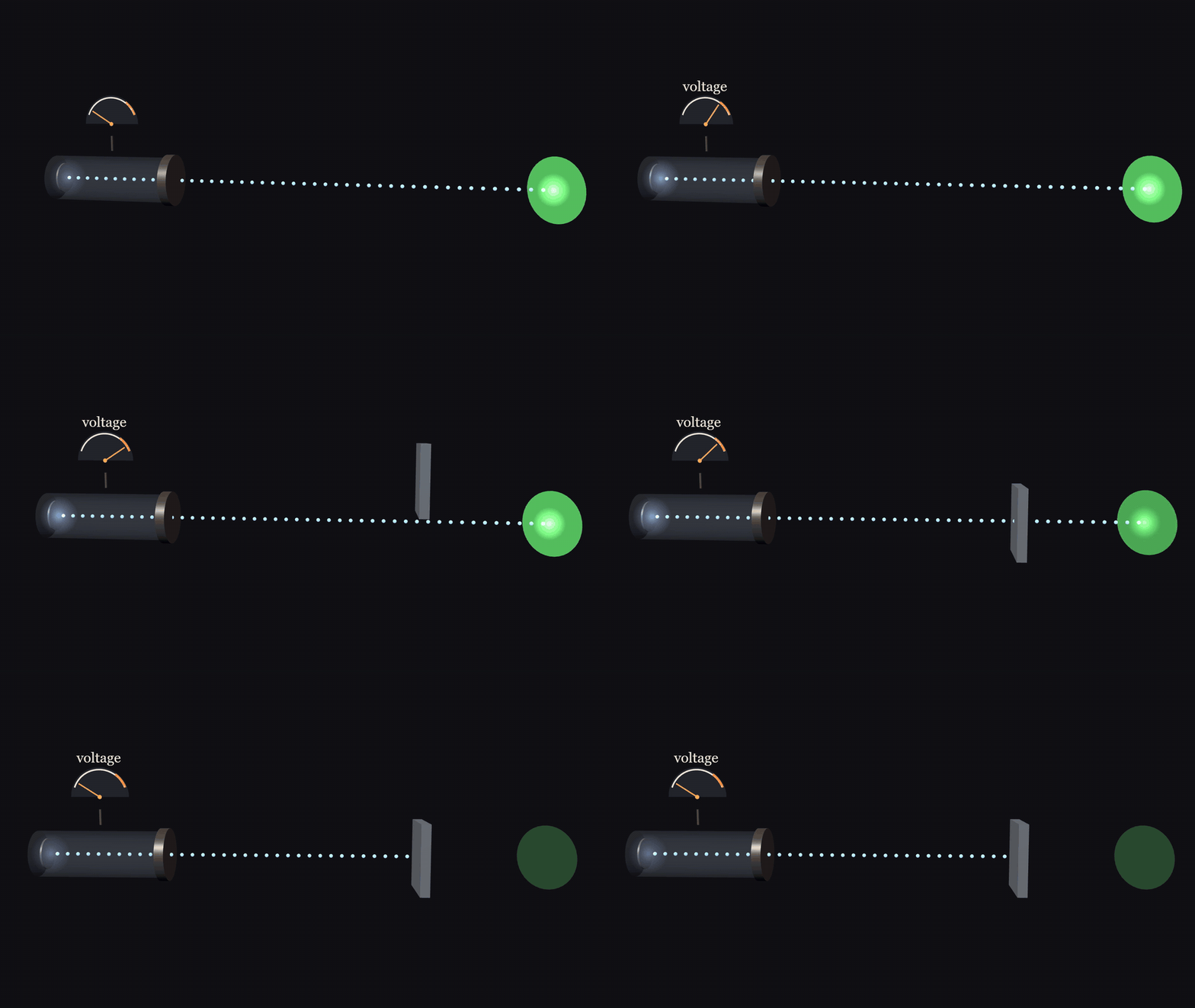
Figure 16. How fast the rays go depends on the voltage across the tube: the higher the voltage, the faster. And the faster the rays, the more easily they get through.
Trying the fastest rays, he found that in a cubic meter block of platinum, a heavy and dense metal, the parts that really stop the rays add up to one cubic millimeter at most, the size of a pinhead; the rest of the block is as empty as the sky.
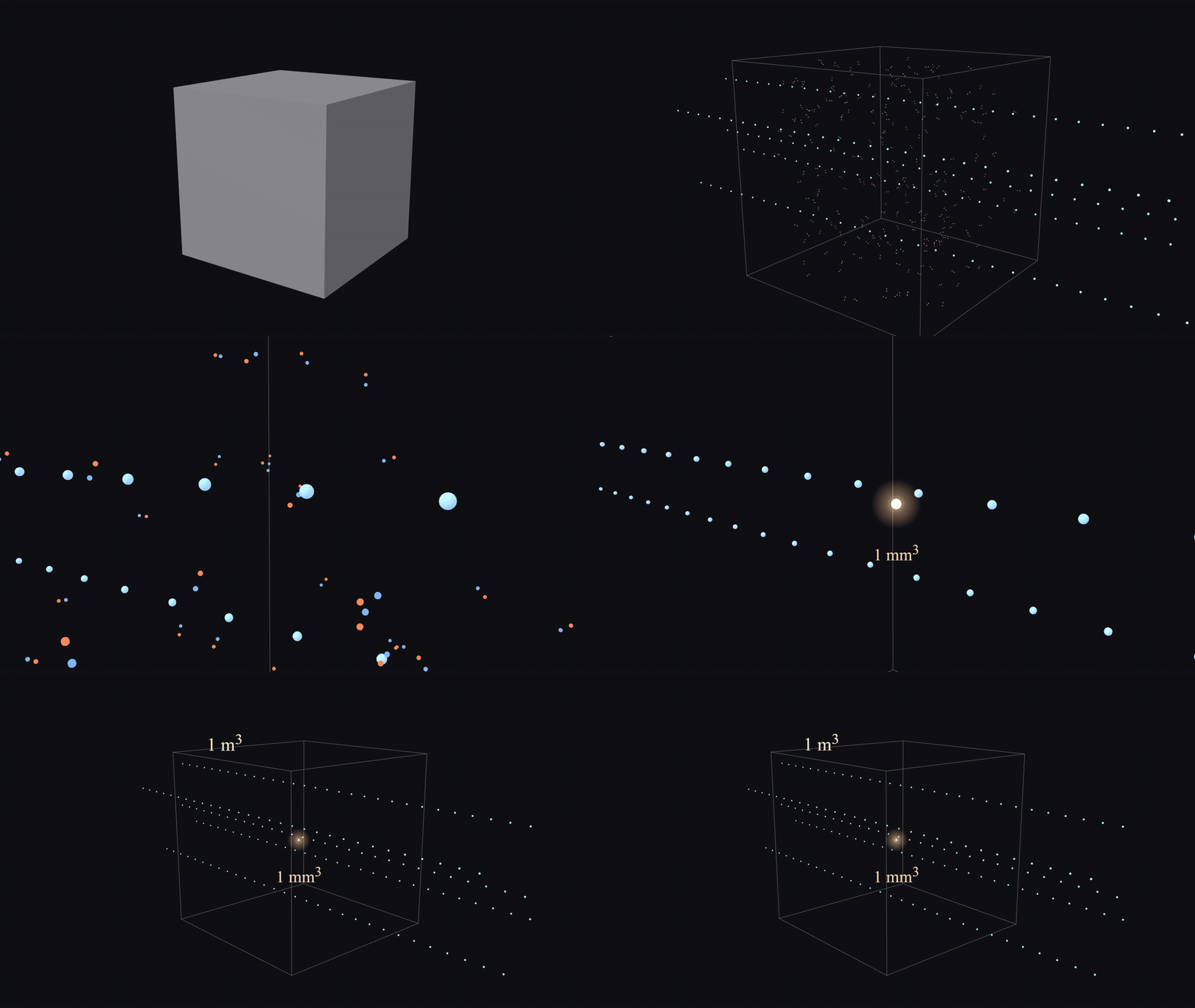
Figure 17. Trying the fastest rays, he found that in a cubic meter block of platinum, a heavy and dense metal, the parts that really stop the rays add up to one cubic millimeter at most, the size of a pinhead; the rest of the block is as empty as the sky.
Most of the atom is empty. Later, from experiments that fired alpha particles at gold foil, Rutherford inferred in 1911 that at the center of the atom sits a very small, very heavy nucleus. Alpha particles carry a positive charge and are several thousand times heavier than an electron.
In these years he also took up something else: light falling on a metal knocks electrons out of it. In 1902 he found that how fast the fastest of these electrons can go has nothing to do with how strong or weak the light is; stronger light only knocks out more of them.
Three years later, Einstein mentioned this work in a paper and called it pioneering. Einstein’s own explanation of the result later won him the prize for 1921. That is a story for another episode.
One result, two explanations
Here we say just one thing about how the two men differed. Lenard’s own explanation, written in his 1902 paper and also given in his Nobel lecture, was this: the energy the electrons have as they come out does not come from the light at all, but from violent motions already present inside the atom; the light only has an initiating action, rather like that of the fuse in firing a loaded gun.
Einstein’s explanation of 1905 was the exact opposite: the energy does come from the light. Light comes in portions, and the energy of one portion depends only on its frequency: it is . An electron absorbs one portion, spends part of the energy on leaving the metal, and what is left is its kinetic energy as it comes out. So the intensity of the light decides only how many electrons are knocked out, not how fast the fastest of them can go; the largest kinetic energy of the electrons coming out rises with frequency along a straight line:
is the energy an electron must spend to leave this metal.
In 1916, in America, Millikan measured by experiment the straight line that Einstein’s equation predicts, and his conclusion was that the equation stood up to every one of the tests he had designed for it. Yet in the same paper he called Einstein’s light-quantum hypothesis bold, not to say reckless, and said that the theory behind it seems at present to be wholly untenable. He confirmed the equation, but did not accept the light quanta behind the equation.
So how does the bending of the rays tell us how fast they go and how light they are? Let’s work it out.
Working it out from the start
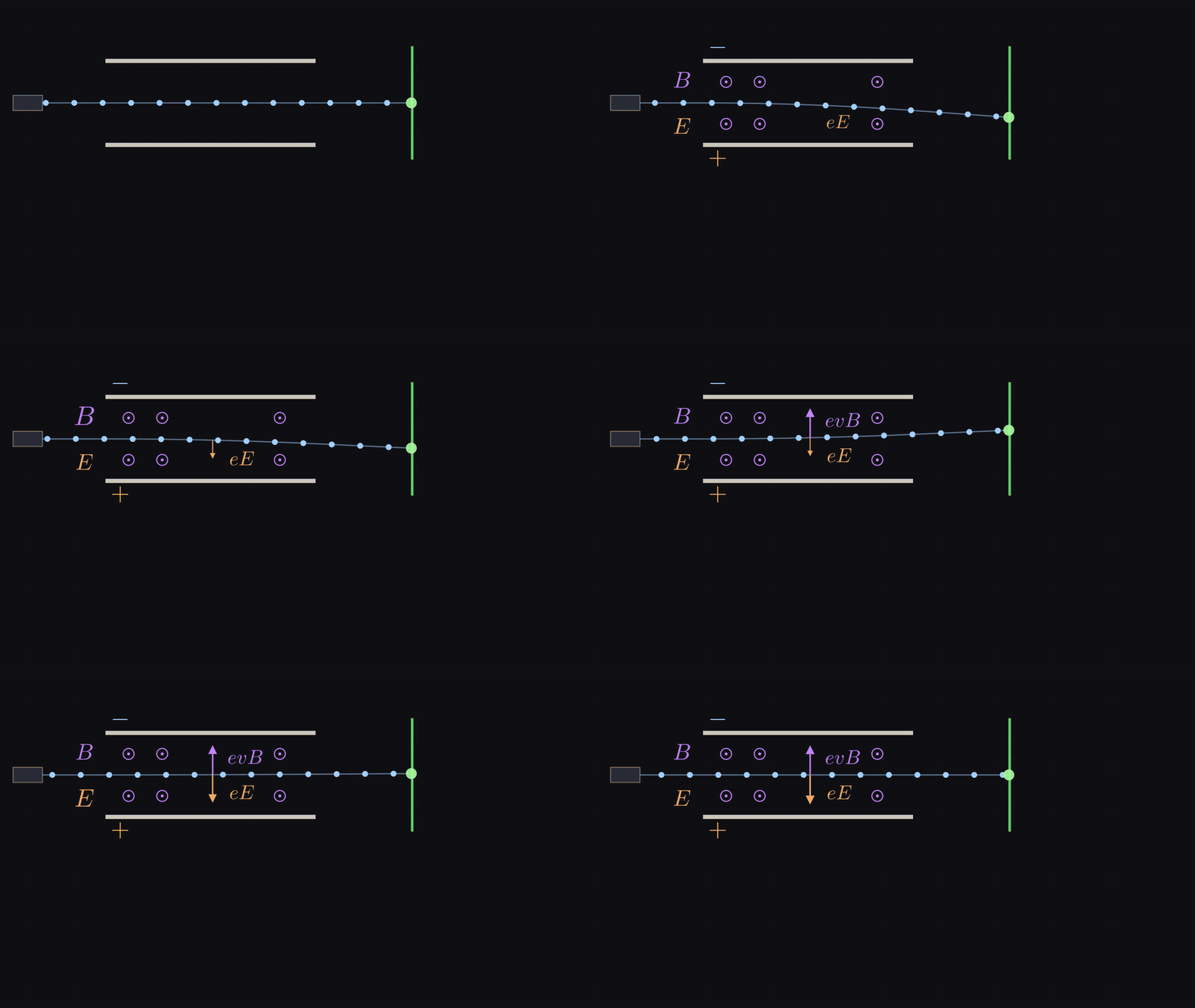
Figure 18. First send the rays through an electric field and a magnetic field at the same time. The electric field pushes a charge to one side, with a force equal to the charge e times the field strength E. With the magnetic field at right angles to the rays, its force on a moving charge is the charge e times the speed v times the field strength B, and with the electric field, the magnetic field and the rays all at right angles to one another, set the right way, it points exactly against the electric push. Set the electric field to just the right value and the two forces balance: the rays do not bend at all, but go straight through.
First, the speed. Send the rays through an electric field and a magnetic field at the same time. The force with which the electric field pushes a charged particle is ; when the magnetic field is at right angles to the rays, the force with which it pushes a moving charge is . With the electric field, the magnetic field and the rays all at right angles to one another, and the directions set the right way, this force points exactly against the push of the electric field. Adjust the electric field until the two forces are exactly equal, and the rays do not bend at all, but go straight through:
For example: an electric field of thirty thousand volts per meter, and a magnetic field of one millitesla:
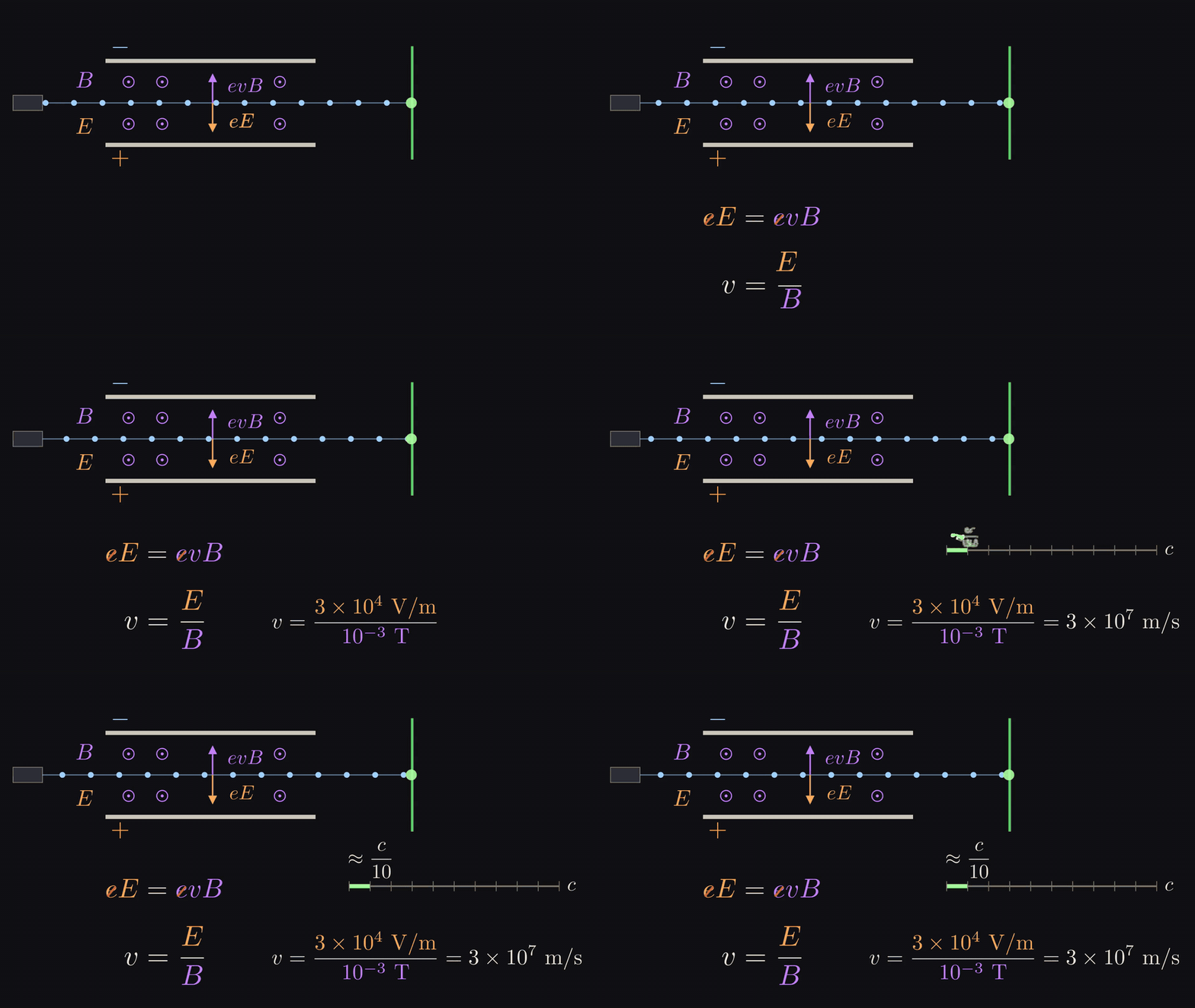
Figure 19. Then e E equals e v B; cancel e on both sides, and the speed v equals E divided by B. For example: with an electric field of thirty thousand volts per meter and a magnetic field of one millitesla, the speed is thirty million meters per second, about a tenth of the speed of light.
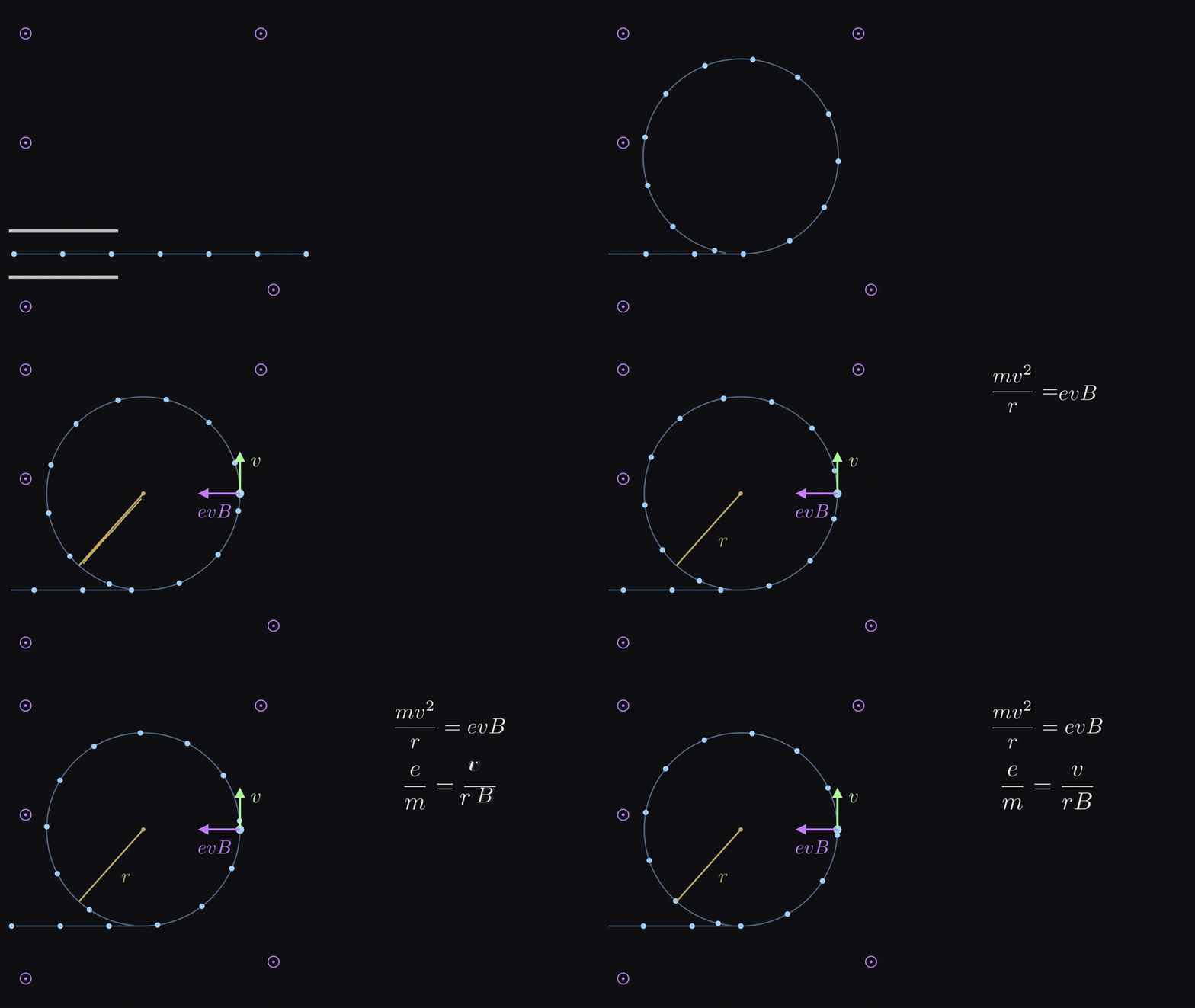
Figure 20. Now switch the electric field off and keep only the magnetic one. The magnetic force stays at right angles to the motion, so the rays follow an arc of a circle. Moving in a circle takes a centripetal force equal to the mass m times v squared, divided by the radius r. Here that force is the magnetic force, e v B. Setting the two equal, m v squared over r equals e v B; and rearranging, e over m equals v divided by r times B.
Next, the charge-to-mass ratio. Switch off the electric field and keep only the magnetic one. The magnetic force stays at right angles to the velocity, the rays follow an arc of a circle, and the magnetic force is the centripetal force:
Measure the radius of the arc, about 0.17 meters, and put it in:
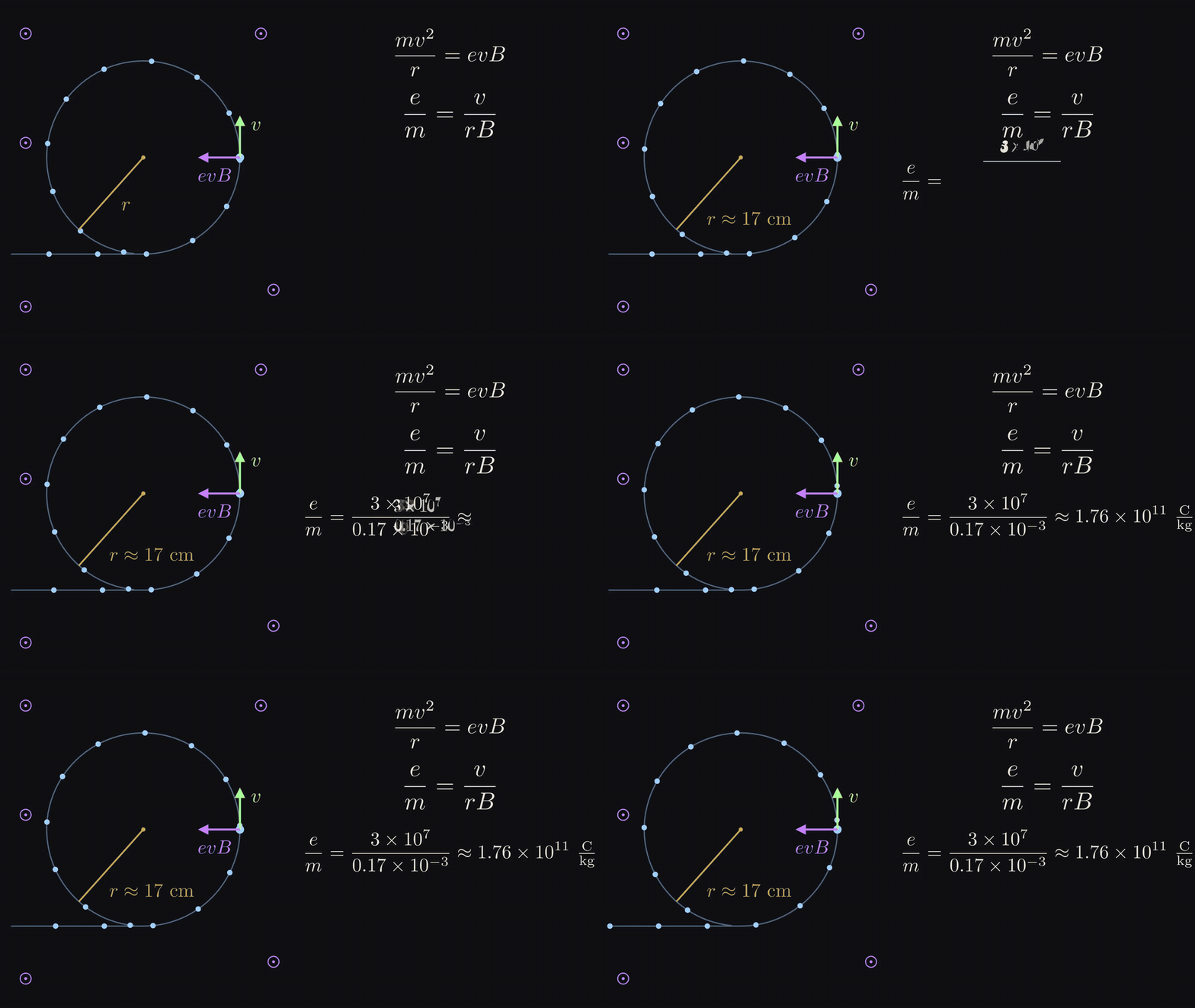
Figure 21. Measure the radius of the arc, about seventeen centimeters, put it in, and you get one point seven six times ten to the eleven coulombs per kilogram.
Compared with the hydrogen ion. In electrolysis, releasing 1 mole of hydrogen atoms (about 1.008 grams, that is, half a mole of hydrogen gas) takes 1 faraday of electricity, about 96485 coulombs, so the charge-to-mass ratio of the hydrogen ion is
Comparing the two:
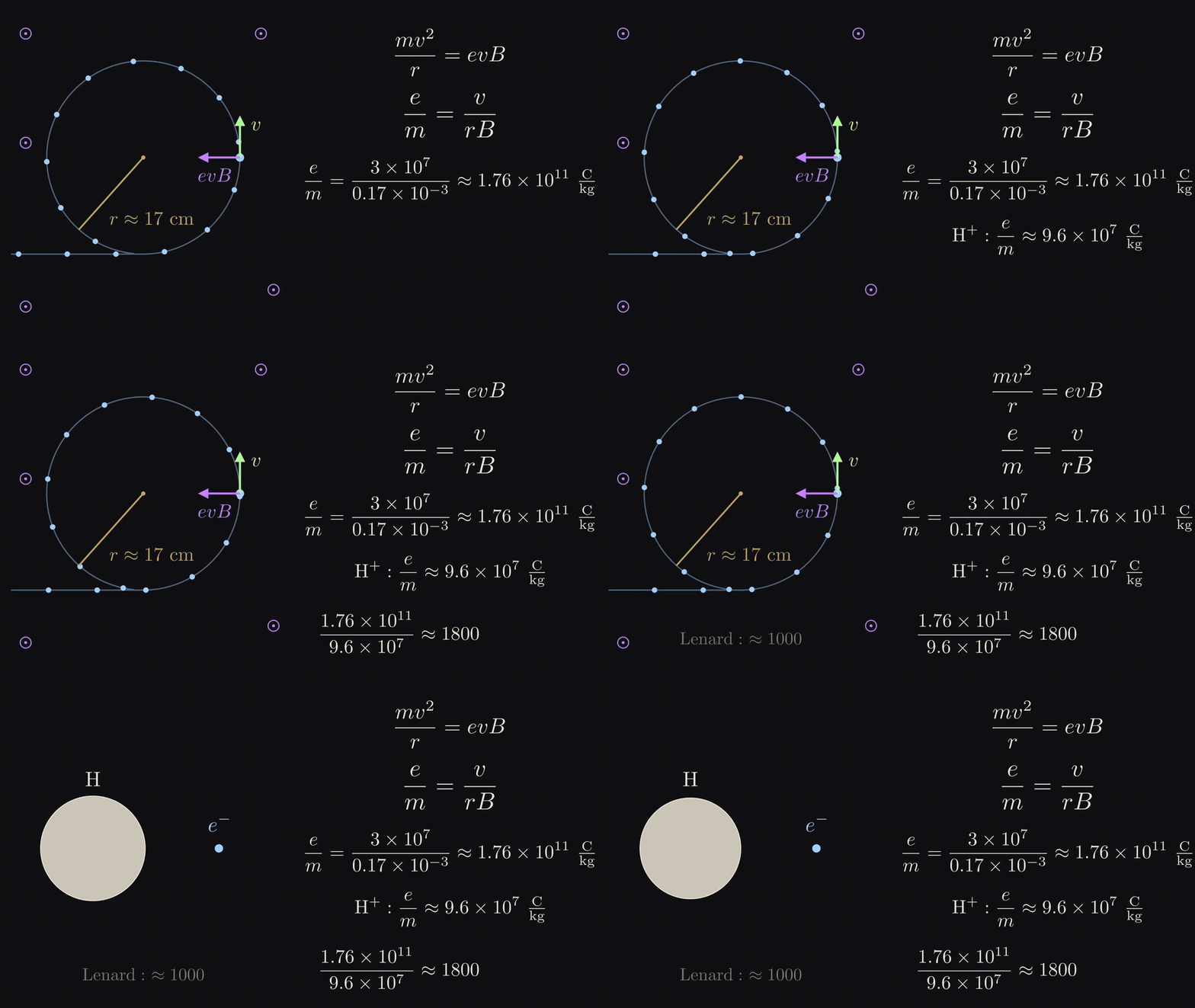
Figure 22. For the hydrogen ion in electrolysis, the same ratio is about ninety six million coulombs per kilogram. Side by side, the two differ by a factor of more than eighteen hundred. Lenard had measured about a thousand. The number is different, the conclusion the same: what the rays are made of is far lighter than the lightest atom.
They differ by a factor of more than eighteen hundred. Lenard had measured about a thousand. The number is different, the conclusion the same: what the rays are made of is far lighter than the lightest atom.
Why the example takes a tenth of the speed of light. What we used above is Newtonian mechanics. The first step is not affected: when the two forces are equal, holds in relativity just the same. What changes is the second step: the closer a particle comes to the speed of light, the larger the radius of the arc it follows in a magnetic field compared with what Newtonian mechanics gives, larger by a factor of
At a tenth of the speed of light , and the charge-to-mass ratio from the formula above comes out too small by only five parts in a thousand; if we took the speed Lenard measured, a third of the speed of light, , it would come out too small by about six percent.
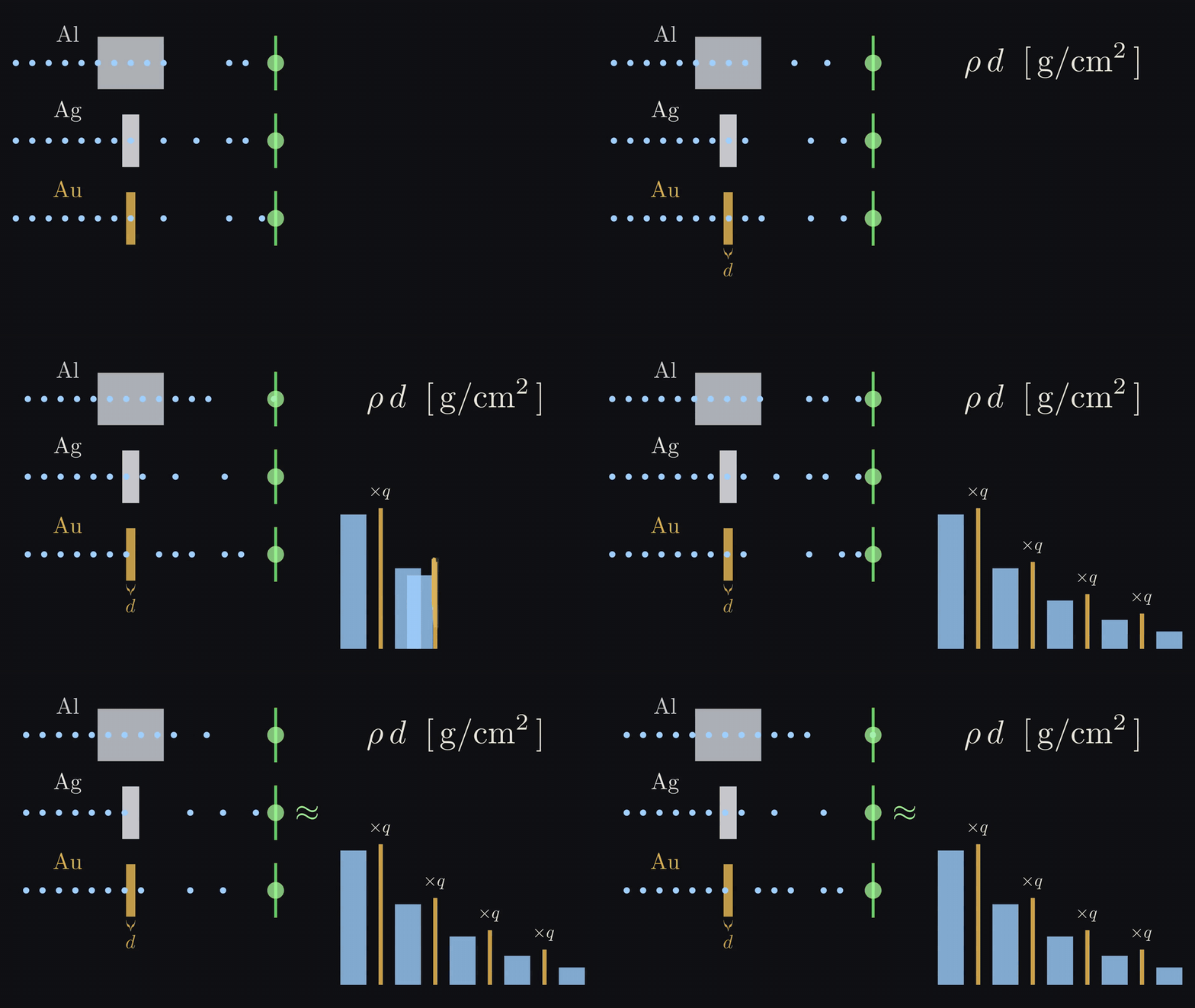
Figure 23. Now back to the rule that only weight matters. What stops the rays is how many grams lie on each square centimeter, that is, the density times the thickness. As long as the layer is not too thick, each further equal amount of this mass thickness cuts the rays getting through by roughly the same fraction. Aluminium, silver, gold: as long as the grams per square centimeter are the same, they stop about the same fraction, and that is just what Lenard measured.
The rule that only weight matters. How much the rays are stopped depends on how many grams there are on each square centimeter; this is called the mass thickness, and it is the density times the thickness:
As long as the layer is not too thick, each further equal amount of mass thickness cuts the rays getting through by roughly the same fraction. Let each amount leave a fraction of the rays; stack such amounts, and is left; written in continuous form, this is
What Lenard measured was that aluminum, silver and gold have nearly the same . As long as the grams per square centimeter are the same, the fraction stopped is nearly the same. (When the layer is thick, this formula no longer holds: electrons of a given speed have a roughly definite range, and beyond a certain thickness not a single one gets through.)
That block of platinum. In a cubic meter, at most a cubic millimeter:
One part in a billion.
The official reason for Lenard’s prize of 1905 was: for his work on cathode rays.
So how did that year’s prize come to him?
December 1905, Stockholm
The first episode of this series told how, for the first Nobel Prize in Physics in 1901, the five members of the physics committee all nominated the same two men, Röntgen and Lenard. The Academy gave the prize to Röntgen alone.
Four years later, it was his turn.
For the physics prize of 1905 there were 27 nominations in all, and only 2 of them were for Lenard.
The most nominated was J. J. Thomson, with 13. Those who nominated him included the Curies, Lorentz, Röntgen, Kelvin, Rayleigh and Ramsay, all of whom we have met in earlier episodes.
In the end, the prize went to Lenard.
On November 9, 1905, the Swedish Academy of Sciences made its decision. His diploma is in the Deutsches Museum today, and the reason it gives is a single line: for his work on cathode rays.
December 10, Stockholm. Lenard did not come, and the German minister received the prize on his behalf. Baeyer, the chemistry laureate of the same year, did not come either.
In that year’s Nobel yearbook, his biography says that Lenard is to be regarded as the forerunner and pathfinder of Röntgen’s discovery.
The presentation speech says that the revolutionary discoveries of recent Nobel laureates, Röntgen, Becquerel and the two Curies, can well be considered the fruits of this impetus.
That was how Stockholm saw it in 1905.
His Nobel lecture was put off until May 28 of the following year. Of Röntgen he said that Röntgen was the first investigator to use the type of tube he had described. It is generally considered a lucky discovery, he said; but given the tube, it appeared to him that this discovery had of necessity to be made at this stage of development.
What the archives say
Of those 27 nominations in 1905, Lenard’s 2 were these: one from van ‘t Hoff, nominating him alone, and one from Vilhelm Bjerknes, nominating him together with Oliver Heaviside.
Among the nominators of J. J. Thomson’s 13, besides the men named above, were also Lockyer, Lodge and others. Thomson won the prize the following year.
Of the other 12, Lippmann had 3; Braun had 1, from Lenard’s teacher Quincke, and won the prize in 1909; Boltzmann had 1, from Planck. And 1 was for Blondlot, the man who had put forward the “N-rays”: in September 1904, the American Wood published an article, “The n-Rays”, in Nature, and exposed them. Yet the next year, Blondlot was still nominated.
The archives record only who nominated whom. Why the committee chose the 2 over the 13, the web pages of the nomination archive do not say.
Nor was this the first time Lenard had been nominated. There were 6 in 1901, and 3 in 1904.
The prize money
The prize money in 1905 was 138,089 Swedish kronor.
Afterwards
In 1897 Mileva sat in on Lenard’s lectures in Heidelberg. She wrote to Einstein: “it was really neat at the lecture of Prof. Lenard yesterday”.
In 1901 Einstein read a paper of Lenard’s, and wrote to Mileva, who would later become his wife, that it filled him with such happiness and such joy.
The turn came in 1918. Lenard published an article against Einstein’s general theory of relativity.
General relativity says this: when a train brakes hard, you can say the train has changed its speed; or you can treat the train as standing still, and then a gravitational field appears inside it, and it is this field that throws everything in the carriage about and smashes it. Einstein said these are not two rival guesses but two ways of describing the same event.
Lenard’s example was just such a train: it changes its motion suddenly, everything inside it is smashed, and everything outside is unharmed; no sound mind, he wrote, would conclude anything but that the train had changed, not its surroundings.
In August 1920, Einstein wrote a reply on the front page of the Berliner Tageblatt. Among physicists of international standing, he said, Lenard was the only one he knew of who openly opposed relativity. He admired Lenard as a master of experimental physics; but in theoretical physics Lenard had done nothing yet, and his objections were superficial.
A month later, at a meeting of physicists in Bad Nauheim, in Germany, the two of them debated face to face.
Lenard said that the simple common sense of a natural scientist ran up against a wall in this theory.
Einstein replied that what counts as intuitive changes with the times. Physics works with concepts, not with intuition.
Relativity has no need for the ether in which light was supposed to travel. In closing, Lenard said that it would be better not to proclaim the “abolition of the ether”.
In the printed record of the meeting, this was an argument about physics.
For the physics prize of 1921, Lenard nominated Gehrcke, an opponent of relativity. In 1923 and 1924 he nominated him twice more.
June 27, 1922, Heidelberg. The rector had ordered lectures to stop, but Lenard held his class as usual.
Workers came, and were met with fire hoses and stones thrown by students. Lenard was then taken into custody, and on the way across the New Bridge he very nearly fell into the river.
The next day’s Berliner Tageblatt report did not say why lectures had been stopped.
Three days earlier, on June 24, the German foreign minister Walther Rathenau had been shot dead in a Berlin street.
Fifteen years later, a commemorative volume from the Nazi years told another version: that day was Rathenau’s funeral, Lenard had not flown the flag over his institute, and the crowd that burst in was a mob led by Jewish students, who threatened to throw him into the Neckar.
One event, two stories.
In 1933 the Nazis came to power. On his 71st birthday the Reich President awarded him the Eagle Shield of the German Reich, engraved on the back: to the great German physicist.
In December 1935, the physics institute of the University of Heidelberg was renamed the “Philipp Lenard Institute”. Nature reported that at the ceremony he “exhorted all to continue energetically the fight against the Jewish spirit”.
In 1936 he brought out the first volume of his four-volume Deutsche Physik. It opens by saying that people have not recognized clearly enough that, just as fleas and elephants differ in mind, so the spirits of different races and peoples differ from one another too.
In the fourth volume of the set, X-rays are not called Röntgen rays but high-frequency rays. In a footnote he wrote that the name “Röntgen rays” had been given by doctors, and that naming a natural phenomenon after a person was unfitting.
At the Nazi Party rally that same year, Hitler awarded him the party’s prize for culture. In 1937 he joined the Nazi Party.
He also wrote a book about the great scientists of the ages. On X-rays, the book speaks only of the discovery of high-frequency rays. The English translation of 1938 does not mention Röntgen’s name anywhere, from beginning to end. In 1943 the book came out in Germany in its 6th edition, with a saying of Hitler’s printed on the title page.
In 1942, when he turned 80, the university in Bratislava gave him an honorary doctorate, and the street where he was born was renamed after him.
As far as the surviving writings show, the grudge was Lenard’s alone: when Röntgen mentioned him in his paper, he listed Lenard’s kind of tube as one of the apparatus that could be used, and praised his experiments.
And by the time those books came out, Röntgen was gone. He died in Munich in February 1923, ten years before the Nazis came to power.
On May 20, 1947, Lenard died in Messelhausen, in Germany, aged 84.
On August 12, 2020, the International Astronomical Union dropped the name of the crater on the Moon that had been named after Lenard.
The window was not dropped. In 1925 William Coolidge of General Electric, in America, published an article in Science whose very first sentence is: Lenard succeeded in getting electrons from a cathode-ray tube out through a thin metal window into the air.
Today the electron beams used to sterilize medical equipment and food packaging also come out of a vacuum through a titanium foil 6 to 10 micrometers thick.
That foil is the little window of 1892.
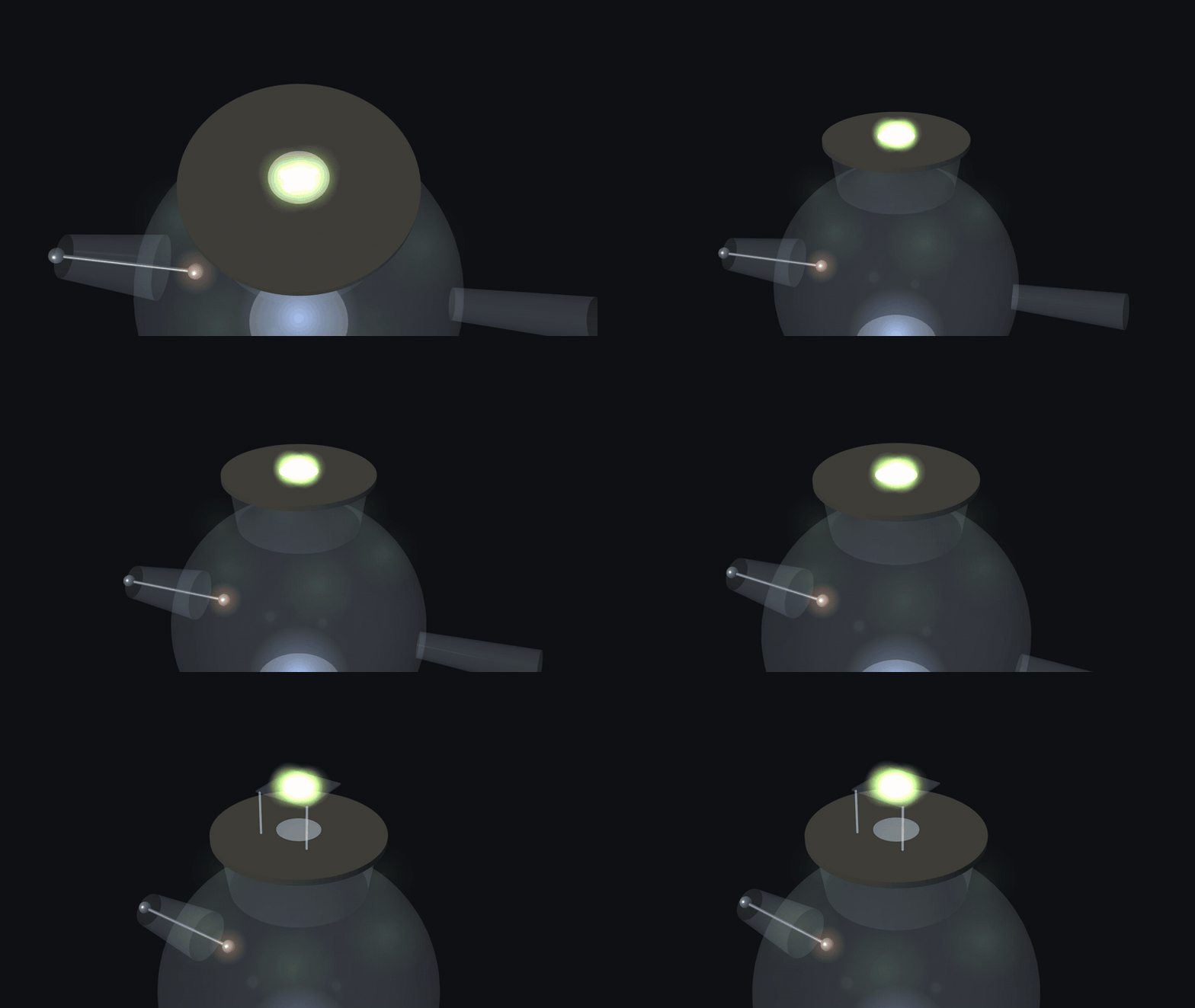
Figure 24. That day, in Bonn, a few grains of phosphor lit up.
That day, in Bonn, a few grains of phosphor lit up.
Looking back on Lenard’s life: from a small window that let rays out into the air, to the Nobel Prize; from a physicist who did his experiments with great precision, to a man who divided physics by nation.
He held firm to his views, and that firmness later turned into stubbornness. His contributions were real, but they cannot cancel out the political road he took.
From each of us to those called great, anyone who is human has flaws. Lenard is one example.
So no theory should close our minds, and no one should be blindly worshipped.
The next episode is 1906, J. J. Thomson: the one who in 1905 had 13 nominations and yet did not win the prize.
References
Numbered in order of first appearance in the main text. [primary] = original documents, newspapers and periodicals of the time, or institutions’ own catalogue records; [secondary] = later research, reference works or retellings.
- P. Lenard, Über Kathodenstrahlen (On Cathode Rays), Nobel lecture, 1906-05-28, nobelprize.org (the official website’s English translation; the German original not checked) [primary]
- A. Lindstedt, presentation speech, 1905-12-10, nobelprize.org [primary]
- A. Einstein, Über einen die Erzeugung und Verwandlung des Lichtes betreffenden heuristischen Gesichtspunkt, Ann. d. Phys. 17 (1905), p.145 (archive.org sim_annalen-der-physik_1905_17_1) [primary]
- Nature 137 (1936), pp.92–93 (the naming of the Philipp Lenard Institute) [primary]
- W. Crookes, Strahlende Materie (German translation of the 1879 lecture) [primary]
- H. Hertz, Ueber den Durchgang der Kathodenstrahlen durch dünne Metallschichten, Wied. Ann. 45 (1892), pp.28–32 (archive.org sim_annalen-der-physik_1892_45_1) [primary]
- P. Lenard, Ueber Kathodenstrahlen in Gasen von atmosphärischem Druck und im äussersten Vacuum, Wied. Ann. 51 (1894), pp.225–267, plate IV (archive.org sim_annalen-der-physik_1894_51_2, _51_4) [primary]
- P. Lenard, Ueber die magnetische Ablenkung der Kathodenstrahlen, Wied. Ann. 52 (1894), pp.23–33 (archive.org sim_annalen-der-physik_1894_52_5) [primary]
- H. Hertz, The Principles of Mechanics, Miscellaneous Papers (English translations), with Lenard’s prefaces, the latter signed 1895-02 (archive.org principlesofmech00hertuoft, miscellaneouspap00hertuoft) [primary]
- W. C. Röntgen, Ueber eine neue Art von Strahlen (the first paper, 1895), §1, §10 [primary]
- Royal Society archives NLB/13/697 (Rumford Medal 1896, Frankland to Lenard) [primary, institutional]
- F. Schönbeck, Lenard, Philipp, Neue Deutsche Biographie 14 (1985), pp.193–195 (deutsche-biographie.de; MDZ scan of the printed volume bsb00016332) [secondary; the “oases” sentence is Lenard’s own words]
- Les Prix Nobel en 1905 (Stockholm, 1907), p.7 (laureates not present), pp.69–70 (biography) (archive.org lesprixnobel00clevgoog) [primary]
- P. Lenard, Ueber die Electricität der Wasserfälle, Wied. Ann. 46 (1892), pp.584–636, signed “Bonn … Mai 1892” [primary]
- Official Nobel Prize: Lenard’s biography and facts pages, nobelprize.org (the biography was rewritten later, so it is used as secondary) [secondary, institutional]
- German Historical Museum LeMO, Philipp Lenard (2014); the University of Kiel’s directory of professors [secondary]
- Berliner Tageblatt, 1922-06-28 evening edition, p.1, Zwischenfall an der Heidelberger Universität; 1922-06-25 morning edition, p.2 (the assassination of Rathenau) [primary]
- J. J. Thomson, Cathode Rays, Phil. Mag. (5) 44 (1897), pp.293–316, p.310 (archive.org londonedinburg5441897lond) [primary]
- E. Rutherford, Phil. Mag. 21 (1911), p.669; H. Geiger, E. Marsden, On a Diffuse Reflection of the α-Particles, Proc. Roy. Soc. A 82 (1909), pp.495–500 [primary]
- P. Lenard, Über die Absorption von Kathodenstrahlen verschiedener Geschwindigkeit, Ann. d. Phys. 12 (1903), pp.714–744 (the platinum-block sentence is on p.739) (archive.org sim_annalen-der-physik_1903_12_4) [primary]
- P. Lenard, Ueber die lichtelektrische Wirkung, Ann. d. Phys. 8 (1902), pp.149–198 (archive.org sim_annalen-der-physik_1902_8_1) [primary]
- R. A. Millikan, A Direct Photoelectric Determination of Planck’s “h”, Phys. Rev. 7 (1916), pp.355–388 (archive.org sim_physical-review_1916-03_7_3) [primary]
- Checks: physical constants taken from CODATA 2018 (Faraday constant, electron charge-to-mass ratio); the derivation checked by Abel (physics-check-script-1905-v0.1/v0.2, verify_s6.py); the numbers in this article independently recomputed by Euler [secondary]
- Lenard’s Nobel diploma and medal, held in the archives of the Deutsches Museum, photographed by Burkhard Mücke (Wikimedia Commons, CC BY 4.0) [primary, institutional]
- Nobel nomination archive, physics prize 1901, 1904, 1905, 1921, 1923, 1924, nobelprize.org/nomination/archive [primary, institutional]
- R. W. Wood, The n-Rays, Nature 70 (1904), pp.530–531 (only the bibliographic record checked) [primary]
- Nobel Foundation prize amount table; official Nobel data API prizeAmount [primary]
- The Collected Papers of Albert Einstein, vol. 1, English translation, p.35 (Mileva 1897), p.174 (Einstein 1901) [primary (in English translation)]
- P. Lenard, Über Relativitätsprinzip, Äther, Gravitation, Jahrbuch der Radioaktivität und Elektronik 15 (1918), p.122 [primary]
- A. Einstein, Meine Antwort, Berliner Tageblatt, 1920-08-27 morning edition, p.1 [primary]
- Physikalische Zeitschrift 21 (1920), pp.666–668 (record of the Bad Nauheim debate) [primary]
- Commemorative volume for Philipp Lenard’s 75th birthday (1937), p.4, p.17 (digitized by the Badische Landesbibliothek) [primary; a Nazi-era publication]
- Posener Tageblatt, 1933-06-09 (the Eagle Shield) [primary]
- P. Lenard, Deutsche Physik, vol. 1 p.2, vol. 4 p.208 and footnote 2 (vol. 1 read in the 4th edition of 1944, vol. 4 in the 3rd edition of 1943) [primary; a Nazi-era publication]
- P. Lenard, Great Men of Science (New York, 1938, translated from the 2nd German edition), p.347; Große Naturforscher, 6th edition (München, 1943), title page [primary; a Nazi-era publication]
- Deutschtum im Ausland 25 (1942), p.173 (the honors at 80) [primary]
- USGS Gazetteer of Planetary Nomenclature, entry Lenard (Feature 14503): “Name dropped on August 12, 2020” [primary, institutional]
- W. D. Coolidge, High Voltage Cathode Rays Outside the Generating Tube, Science 62 (1925-11-13), pp.441–442 (archive.org sim_science_1925-11-13_62) [primary]
- IAEA, Use of Mathematical Modelling in Electron Beam Processing: A Guidebook (Radiation Technology Series No. 1, Vienna, 2010), p.3, p.6 (the titanium window of the electron beam; the book does not use the term “Lenard window”) [secondary, institutional]